OECD Lowers Bulgaria’s Growth Forecast, Sees Moderate Expansion Through 2026
The Organization for Economic Co-operation and Development (OECD) now expects Bulgaria’s economy to grow by 2.6% in 2025
Business | June 3, 2025, Tuesday // 13:27
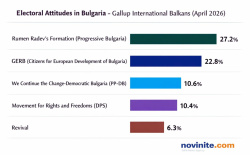
HOT: » Which party would you vote for (if you could) in the upcoming snap vote in Bulgaria on April 19?
 Send to Kindle
 Bulgarian Finance Minister Simeon Djankov. Photo by BGNES
Bulgaria's Finance Ministry has reacted to Thursday's drastic lowering of the European Commission economic forecast for the country with a relativistic approach.
Bulgaria's economy will register a growth of 1.4% in 2012, stated the February Interim Economic Forecast of the European Commission unveiled Thursday.
Brussels's new growth forecast for Bulgaria is 0.9 pp lower than it was in November 2011; it estimates Bulgaria's 2011 GDP growth at 1.8%, after the 0.2% growth in 2010.
"In spite of the lowered forecast, the European Commission ranks Bulgaria fifth in the EU by projected 2012 economic growth," the Bulgarian Finance Ministry has reacted in a special statement.
It stressed that the EC does not have any expectations that Bulgaria might slip into a recession, and points out that Bulgaria's economic growth is expected to be weaker in the first half of the year, and to grow stronger towards the end of 2012.
"We remind that Bulgaria's 2012 budget has been drafted conservatively with a 1% GDP growth projection. According to the EC document, nine EU member states will see negative growth in 2012, one will have zero growth, and 17, including Bulgaria, will have positive growth," said the Bulgarian Finance Ministry.
It also mentioned the major indicators of the Bulgarian economy assessed positively by the European Commission: the stability of the banking sector, public finances, gradual recovery of domestic demand, and the stabilization of the labor market.
At the end of 2011, Bulgaria's Finance Minister Simeon Djankov announced that the 3.7% economic growth projected in the 2012 State Budget Act was too optimistic and the Bulgarian government lowered its forecast to 2.3.%. He later said the budget had been modified to work out even in the even of a 1% GDP growth in 2012.

The Organization for Economic Co-operation and Development (OECD) now expects Bulgaria’s economy to grow by 2.6% in 2025

The European Commission has referred Bulgaria, along with Spain, Hungary, the Netherlands, Austria, Portugal, and Finland, to the Court of Justice of the European Union for failing to transpose

The European Commission (EC) has presented data regarding several criminal proceedings linked to the enforcement of EU law, with Bulgaria involved in seven of these cases

The European Commission has issued four reasoned opinions to Bulgaria, marking the final stage before potentially referring the country to the Court of Justice of the European Union

The European Commission has emphasized the urgent need for immediate action to eliminate the recent plague outbreak in the Bulgarian town of Velingrad

The European Commission (EC) has initiated criminal proceedings against Bulgaria and 22 other EU member states for failing to fully implement critical cybersecurity regulations

Bulgaria recorded only a modest and one-off increase in inflation following the adoption of the euro on January 1, with the effect estimated at between 0.3 and 0.4 percentage points

Data released by the Ministry of Finance, covering budget execution for February 2026 and preliminary estimates for March 2026, indicate a marked deterioration in Bulgaria’s fiscal position

In the 2026 edition of the Index of Economic Freedom, compiled by the Heritage Foundation, Bulgaria is placed 38th out of 176 countries, positioned between Costa Rica and Oman

Finance officials and the Bulgarian National Bank have issued a series of warnings about Bulgaria’s fiscal and economic outlook for 2026, highlighting rising pressure on public finances, slower growth, and higher inflation.

With the initial months following the introduction of the euro, institutional oversight in Bulgaria is gradually shifting from intensive inspections to a more systematic and long-term monitoring framework

Bulgarian National Bank Governor Dimitar Radev has warned that inflation risks are increasingly driven by geopolitical developments, stressing that Bulgaria remains firmly anchored within the European institutional and political framework

Aniventure Comic Con Returns to Bulgaria with Star Guest Christopher Judge!
Global Fuel Shock: Oil Jumps Over 40% Since Iran War Began