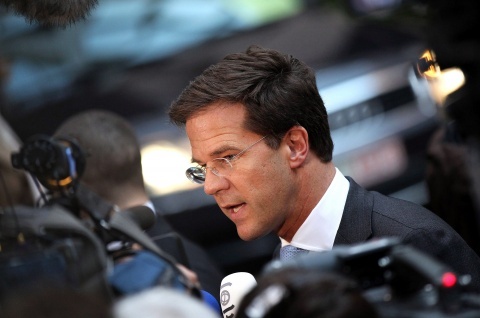
Dutch Prime Minister Mark Rutte. Photo by EPA/BGNES
By Peter Cluskey
The Irish Times
In a stinging embarrassment for his coalition government, Dutch prime minister Mark Rutte has been called before the European Parliament to explain his "deafening silence" over a right-wing website inviting complaints about Polish, Romanian and Bulgarian immigrants.
The summons represents a moment of extraordinary irony in Dutch politics, given that it is Mr Rutte who is being called to Strasbourg "to explain the position of his government" – rather than Geert Wilders, whose anti-immigrant Freedom Party (PVV) actually launched the site earlier this month.
Issuing the summons to a special debate on March 13th, the chairman of the European People's Party grouping, French MEP Joseph Daul, agreed with the EU commissioner for justice, Viviane Reding, who condemned the PVV site last week as "an open call to intolerance".
"I am angered that anyone could attack fellow Europeans," Mr Daul said. "It is against all European and indeed human values to attack a particular group of people in this way. It is reckless to encourage hate and discrimination."
The controversy over the website – which has also been condemned as discriminatory by 10 central and eastern European countries, employers, trade unions, MPs and MEPs – is the most striking example to date of the leverage Mr Wilders exercises over the minority Liberal – Christian Democrat coalition.
While the PVV's position as anti-immigrant comes as no surprise, opinion polls show that a traditionally tolerant Dutch public has been taken aback by Mr Rutte's repeated refusal to "take a stand" against the website – for what appear to be reasons of straightforward political expediency.
The PVV, which is not a government party, supports the coalition's tough austerity programme in return for a hard line on immigration and policing – and Mr Rutte will be depending on Mr Wilders in a fortnight's time when he attempts to force ?24 billion in budget cuts through parliament.
Opposition parties claim Mr Rutte is "afraid" that if he openly condemns the PVV website, he will lose Mr Wilders's support – and opposition to the cuts could bring down the government.
"I hope he will soon realise that, in the eyes of many abroad, keeping silent makes him an accessory to this unacceptable rabble-rousing against fellow Europeans", said Labour's Frans Timmermans.
Gerard Schouw, an MP with the centre-left party D66, who caused a stir when he branded the prime minister "a coward" for failing to condemn the PVV website, says he is unapologetic: "In these circumstances you have to stand up for your democratic principles, and he didn't.
"I told Mark Rutte, 'You must draw your red line and tell people who are deeply worried about the PVV website campaign that you agree: you don't want this in our country.
"Rutte looks scared now because he is not standing up to the PVV, and the public knows that. I also think he underestimated the effect it would have in Europe – and now he's refusing to back down."
Deputy prime minister Maxime Verhagen, leader of the Christian Democrats, has attempted to relieve some of the pressure, but has been accused of doing too little too late.
"This cabinet stands for the free movement of workers", Mr Verhagen said.
"East Europeans have made a great contribution to our economy. But we cannot shut our eyes to problems such as unfair competition, exploitation and nuisance."
*The title of the article has been changed by the Editorial Staff of Novinite.com