Some commissioners-designate are more stressed than others ahead of their hearings in the European Parliament, which start next week, sources told EurActiv. Bulgarian candidate Rumiana Jeleva in particular needs to "come clean" following conflict of interest allegations, Parliament insiders said.
MEPs will grill the commissioners-designate of the Barroso II team from 11 to 19 January.
Parliament sources told EurActiv that the hearings will concentrate mostly on policy and less on the personality of the candidates, although some will need to "come clean" about their past or conflicts of interest.
As a novelty, centre-left MEPs invited members of the public to submit online questions to commissioners-designate. In a press release, Socialists & Democrats (S&D) group Vice-President Hannes Swoboda (Austria) says his group wants to make sure that "only the best possible candidates" are appointed for the next five-year term.
Communist 'witch hunt'?
Swoboda also appears to pre-empt attacks by the centre-right on the "communist past" of some candidates, presumably Slovak Maroš Šef?ovi?, Czech Štefan Füle and Estonian Siim Kallas.
Kallas, who was also a member of the first Barroso team, is the only one to have indicated in his CV that he was a member of the Communist Party of the Soviet Union between 1972 and 1990.
Barroso himself was a Maoist activist in his native Portugal during his youth, but does not mention this in his official biography.
Hungarian Commissioner-designate László Andor has reportedly not been a member of his country's communist party, but he stands accused by the centre-right Fidesz party of being a "neo-Marxist".
"The hearings must not be turned into a circus by a few right-wingers who are obsessed with the ridiculous fear that the new Commission will be packed with closet communists. What affiliations people had 40 years ago in a Europe that was completely different from the one we live in today has no bearing on the challenges that face the European Union for the future," Swoboda said.
U-turn
The centre-right European People's Party (EPP), the largest group in Parliament, had previously pledged it would prevent former communists from acceding to the EU executive.
But it now appears less interested in attacking the commissioners-designate on such counts.
"We consider that hearings should be conducted in a political spirit and without personal attacks," EPP spokesperson Antoine Ripoll told EurActiv, adding that his group opposed any kind of "witch hunt".
Ripoll said this did not represent a departure from previous EPP policy as the intention was to prevent former senior party officials who had participated in extremist acts from acceding to top EU positions. It was not simply directed against those who had been communists in the past, he insisted.
The spokesman also rejected suggestions that the EPP's sudden policy change could be explained by Bulgarian Commissioner-designate Rumiana Jeleva's position in the EPP, where she holds the post of vice-president. Jeleva is seen as controversial due to allegations regarding her husband's links with a shadowy business group in Bulgaria with ties to Russia.
But Ripoll rejected that too. "I cannot see what is reproached to Ms. Jeleva. Her husband is not condemned or suspected of any wrongdoing, there is no lawsuit against him […] I see all this in a national Bulgarian context, also because the policy of the new [Bulgarian] government against corruption is pretty drastic. Obviously this creates reactions, and one should seek there the explanations for those attacks".
Ripoll did concede that it may appear as though the EPP was speaking out against personal attacks in order to protect its own candidates, but he said there was another aspect – the European Parliament is about to use its new powers from the Lisbon Treaty for the first time and the EPP wants the institution to present its best profile.
"We do not want to provide the sad show of personal attacks - this includes also our camp - or of fighting national conflicts. The European Parliament is not the place to fight such conflicts," he said.
Asked if Jeleva herself should have explained the situation regarding her husband's businesses, Ripoll said that the EPP respected her tactic of answering questions during the hearing, not before.
A source from the liberal ALDE group said that if Jeleva were to seem problematic following the hearings, a decision would be taken to postpone the vote on the whole Barroso II team, scheduled for 26 January. Instead of risking voting out the entire EU executive over one candidate, changes would be made, the source said.
British MEP Andrew Duff (ALDE) said that any postponement of the vote would depend on the performance of the candidates. If there is a serious problem with one or two of them, Barroso will be obliged to act "as fast as he can" to solve it. A delay would be "most unfortunate," Duff said, adding that the Parliament would not be obstructionist because it also wanted the Commission to be in place as soon as possible.
Speaking about Jeleva, Duff admitted that "she's got some questions to answer," but expressed his certainty that she would be prepared to answer them. "I would not speculate at this stage," he concluded.
Written answer blunder?
Another hearing during which personal attacks should be expected is that of Catherine Ashton, the EU's new High Representative for Foreign Affairs and vice-president for external relations in the Barroso II team. However, those allegations are not expected to harm her.
She has already responded to accusations from the United Kingdom Independence Party (UKIP), which asked her if she had taken money from the Soviet bloc countries in the 1980s, when she was working for an anti-nuclear weapons campaign group.
Ashton's hearing is keenly anticipated, mostly due to the fact that she may be asked to explain her written answer to MEPs that her "first priority will be to build the European External Action Service" (EEAS). According to the Lisbon Treaty, the High Representative must conduct the Union's common foreign and security policy, not build the External Action Service, which is seen as the duty of member states, insiders told EurActiv.
For his part, Andrew Duff said Ashton's approach was "absolutely correct" as the majority of MEPs had agreed that the EEAS would be put in place "before Mr [David] Cameron becomes [UK] prime minister".
As juicy as the personal details may appear, Parliament sources said that most MEPs' questions would refer to the capacity of the candidates to assume their portfolios, as well to the chain of command, the internal functioning of the Commission and the sharing of responsibilities between directorate-generals, as well as to inter-institutional relations.


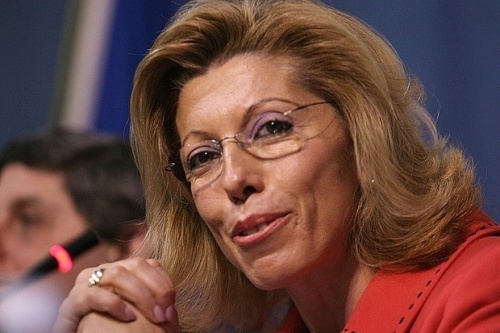 Bulgarian candidate Rumiana Jeleva in particular needs to "come clean" following conflict of interest allegations. Photo by BGNES