Transparency International’s Corruption Perceptions Index for 2025 paints a bleak picture, showing that corruption remains entrenched worldwide and that attempts to reduce it have largely failed. The latest findings underline that global levels of corruption continue to be dangerously high, with little evidence of effective countermeasures.
Bulgaria’s sharp decline
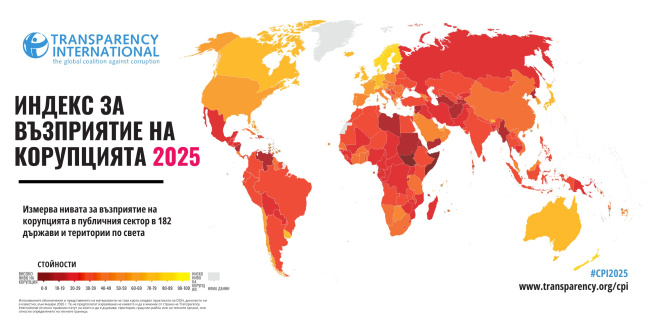
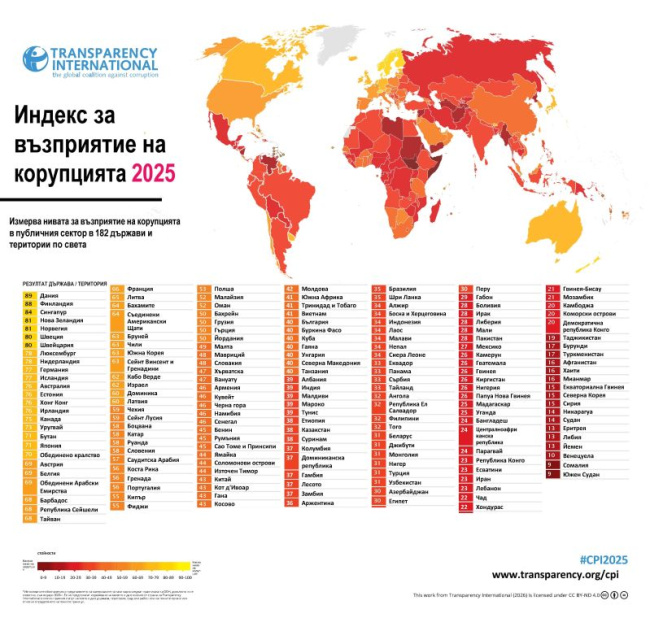
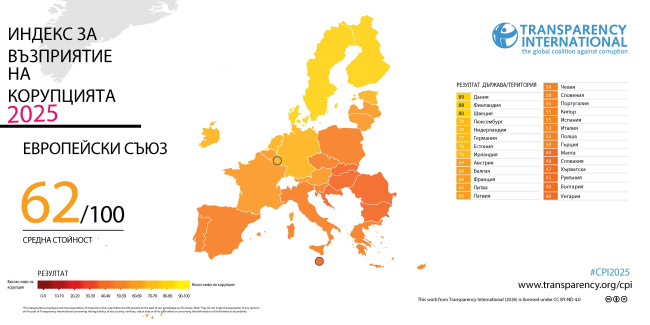
In the 2025 index, Bulgaria scores 40 points out of a possible 100, placing it below the critical 50-point threshold that signals serious structural problems. Alongside Hungary, Bulgaria shares the lowest result among EU member states. The country ranks 84th out of 182 countries and territories assessed, marking its worst performance since 2012.
Over the past two years alone, Bulgaria has lost five points. This drop is statistically significant and points to the absence of consistent and determined anti-corruption policies. According to the analysis, the decline is linked to the continued influence of entrenched kleptocratic networks, the largely formal and ineffective application of anti-corruption measures, growing pressure on civil society, and deep institutional instability surrounding the partially annulled parliamentary elections.
Institutional weakness and political instability
The negative trajectory is closely tied to a deteriorating institutional environment. Ongoing political crises, combined with sustained attacks on civil society organisations, have weakened oversight and accountability. The unprecedented partial annulment of parliamentary elections has further shaken public trust in democratic processes.
Additional concerns stem from prolonged delays in appointing leadership to key regulatory bodies. The closure of the Anti-Corruption Commission, after years marked by inefficiency and an inability to function effectively, has deepened the governance vacuum and intensified doubts about the state’s capacity to address corruption in a meaningful way.
Pressure on civil society
Over the past year, civil society has faced targeted campaigns of stigmatization. These include legislative initiatives aimed at restricting the work of non-governmental organisations and the creation of parliamentary bodies tasked with scrutinising the activities and funding of NGOs. Such measures have fostered a hostile environment for civic engagement and have undermined transparency, accountability and the protection of fundamental rights.
At the same time, the inability of institutions to renew or appoint governing bodies has become a persistent feature of the political landscape, reinforcing perceptions of paralysis and weak state capacity.
Elections and democratic credibility
Serious questions about the resilience of Bulgaria’s democratic system arose after the partial annulment of the 2024 parliamentary elections. A Constitutional Court ruling that invalidated the election of 17 MPs exposed significant flaws in electoral administration and inter-institutional cooperation. The preparation of expert reports was criticised for lacking transparency and was accompanied by public disputes between institutions and allegations of political pressure.
Impact on the business environment
Corruption continues to weigh heavily on Bulgaria’s economy. Business surveys indicate that 55 percent of companies consider corruption a major obstacle to their operations, while 89 percent view it as widespread. This perception translates into higher risks in administrative procedures, public procurement and investment planning.
State capture and strategic corruption distort market competition by favouring companies linked to networks of influence rather than those with stronger economic or professional performance. As a result, investment is discouraged, predictability is reduced, and the impact of economic reforms is weakened. In parallel, entire sectors of the economy continue to rely on undeclared work and grey financial flows, increasing the risks of money laundering and undermining financial stability.
Bulgaria at the bottom of the EU and lagging behind the OECD
Within the European Union, progress against corruption remains stalled, with the average score holding at 62 points. Bulgaria once again occupies last place, together with Hungary. The country also continues to fall short in implementing recommendations from the European Commission, GRECO and the OECD, particularly in areas such as lobbying regulation, integrity standards and the effective enforcement of anti-corruption laws.
In the context of Bulgaria’s bid for OECD membership, the country ranks 35th out of 38 OECD states in the index, placing it among the weakest performers in the organisation.
Call for decisive action
The 2025 Corruption Perceptions Index highlights how inconsistent reforms, political turbulence and fragile institutions continue to obstruct Bulgaria’s efforts to tackle corruption. Without stronger rule of law, genuine institutional independence and the effective application of anti-corruption mechanisms, the country risks further deterioration that will affect both democratic governance and long-term economic development.
About the index
The Corruption Perceptions Index has been published annually since 1995 and assesses perceptions of public sector corruption in 182 countries and territories. It is based on data from 13 independent sources, including international financial institutions and business surveys. The assessments rely on evaluations by experts and business representatives, with the most recent methodological review conducted by the European Commission’s Joint Research Centre in 2017.