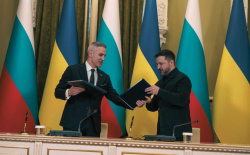
Bulgaria Marks Holy Saturday Ahead of Easter Night
Holy Saturday, known in Bulgaria as Lazarus Saturday’s continuation of the Easter cycle, is a quiet but deeply symbolic day in the Orthodox Christian calendar
HOT: » Which party would you vote for (if you could) in the upcoming snap vote in Bulgaria on April 19?
 Send to Kindle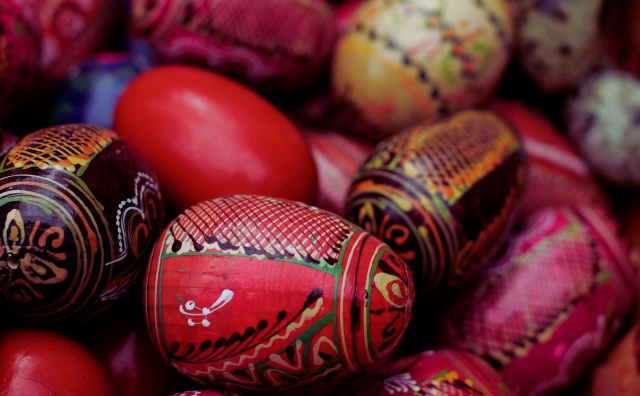
Holy Thursday marks one of the most significant days in Holy Week, as Christians reflect on the final moments before the crucifixion of Jesus Christ. The period is traditionally associated with growing solemnity, as it precedes the suffering and death of Christ on the cross.
On this day, the Church commemorates the Last Supper, during which Christ established the sacrament of the Eucharist by giving communion to his apostles. Following the meal, he withdrew to the Garden of Gethsemane to pray, shortly before being betrayed by Judas. In churches, twelve Gospel passages recounting Christ’s suffering are read, while clergy symbolically carry the cross from the altar, representing its path to Golgotha.
Holy Thursday is also closely tied to long-standing traditions, most notably the dyeing of Easter eggs and the preparation of festive bread (kozunak) for the upcoming celebration. These customs are widely observed across the country as part of the spiritual and cultural preparation for Easter.
In Sofia, the Holy Metropolitanate is once again organizing a public event under the title “Holiday of the Orthodox Spirit and Traditions.” It begins at 10:00 a.m. on St. Nedelya Square with egg painting and sports activities. A festive procession is scheduled to follow at 11:30 a.m., led by clergy and children carrying icons and baskets filled with decorated eggs, making its way to the historic church “St. Petka.”
Theologian Assoc. Prof. Kostadin Nushev described the day as a time of deep reflection on both the spiritual and physical suffering of Christ. He highlighted the importance of the Last Supper, noting that it established the Eucharist, which continues to be observed in every liturgy. He also pointed out that the ritual of Great Unction is performed, offering believers who have observed the 40-day fast a blessing as they enter the final days of Holy Week.
“The week is not only mournful,” Nushev said, “it carries faith, hope and expectation of the Resurrection,” adding that Christ, though without sin, “voluntarily accepted suffering in order to redeem humanity.”
Holy Saturday, known in Bulgaria as Lazarus Saturday’s continuation of the Easter cycle, is a quiet but deeply symbolic day in the Orthodox Christian calendar
The Bulgarian Orthodox Church has decided that no official delegation will travel to Jerusalem this year to receive the Holy Fire, citing the ongoing tensions in the Middle East
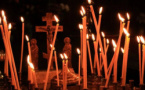
Holy Week has begun, marking the final days of the earthly life of Jesus Christ, the Bulgarian Orthodox Church announced, outlining the sequence of services that will be held across the country

Disturbing footage from a Bulgarian farm exposes the grim truth behind eggs labeled with code 3

Holy Saturday marks the final day of Holy Week, positioned between the sadness of Christ’s entombment and the joy of His anticipated resurrection

On Maundy Thursday, it is customary in Bulgaria to dye Easter eggs, starting with the most important one—the first egg must always be painted red
Holy Saturday, known in Bulgaria as Lazarus Saturday’s continuation of the Easter cycle, is a quiet but deeply symbolic day in the Orthodox Christian calendar
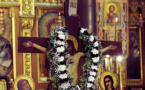
Good Friday, known in Bulgaria as Razpeti petak, is one of the most solemn and deeply observed days in the Orthodox Christian calendar
The Bulgarian Orthodox Church has decided that no official delegation will travel to Jerusalem this year to receive the Holy Fire, citing the ongoing tensions in the Middle East

Plovdiv will host the International Street Arts Festival 6Fest from April 20 to 26, 2026, turning the city into an open-air stage featuring performers from 11 countries across three continents
Holy Week has begun, marking the final days of the earthly life of Jesus Christ, the Bulgarian Orthodox Church announced, outlining the sequence of services that will be held across the country
Tsvetnitsa, known in English as Palm Sunday, is one of the most widely celebrated spring holidays in Bulgaria

Aniventure Comic Con Returns to Bulgaria with Star Guest Christopher Judge!
Global Fuel Shock: Oil Jumps Over 40% Since Iran War Began