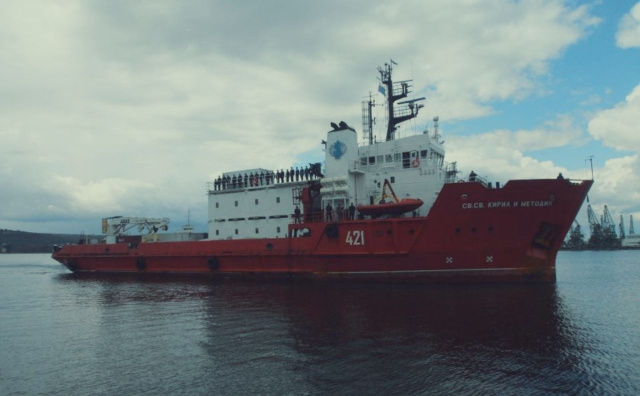
The Bulgarian scientific research vessel “Sts. Cyril and Methodius” (NIC 421) has returned to Varna, docking at the Marine Station and marking the official end of the country’s 34th Antarctic expedition. The ship arrived after a months-long mission, bringing back researchers and crew who had spent nearly five months working in some of the harshest conditions on Earth.
This year’s expedition placed a strong emphasis on studying ocean dynamics, particularly the currents in the Bransfield Strait between the South Shetland Islands and the Antarctic Peninsula. To support the research, the vessel was equipped with specialized instruments, including wave-monitoring radar systems and drifting buoys designed for data collection and analysis. According to expedition leader Prof. Hristo Pimpirev, the mission ranks among the most successful so far, with a focus on “the future of the planet,” including rising sea levels and the broader impact of climate change. He noted that the team examined processes that could lead to the flooding of vast coastal regions, describing them as “extremely dangerous for humanity.”
The journey back to Bulgaria followed a long maritime route through key waterways, including the Western Mediterranean, the Strait of Messina, the Ionian and Aegean seas, as well as the Dardanelles, the Sea of Marmara, the Bosphorus and finally the Black Sea. The vessel had departed Antarctica on February 17, with its final foreign stop in the Spanish port of Cartagena before setting course for Varna on April 2.
Part of the return voyage also served a training purpose. Cadets from the Nikola Vaptsarov Naval Academy, along with trainees from Romania, Poland and Norway, joined the ship in Cartagena for a short-term navigation exercise. They specialized in areas such as ship handling, engineering systems and communications, while also undergoing safety training, including drills with life-saving equipment.
Crew members described both the emotional and physical intensity of the mission. “When you return after five months and see your loved ones, the feeling is indescribable,” said senior seaman Ivaylo Nikolov, highlighting the strong bonds formed on board. The voyage itself was not without difficulty. Captain Radko Muevski recalled encountering a severe storm near 42 degrees south latitude that lasted around 20 hours, calling it “a serious test” and a reminder of the need to respect the sea.
Among those on board was Dr. Denis Ismailov from the Military Medical Academy, who took part in the mission to support the expedition. Meanwhile, scientific infrastructure in Antarctica continues to expand, with the first meteorological laboratory now operating at the Bulgarian base on Livingston Island.
Despite the extreme environment and logistical challenges, all major objectives of the expedition were completed. The mission not only advanced scientific understanding but also reinforced Bulgaria’s role in polar research, with Prof. Pimpirev stating that the country now stands “at the center of world polar science” thanks to its continued presence and work in Antarctica.