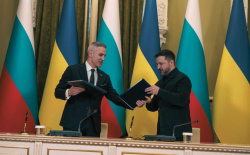
Is Russian Oil Flowing to Bulgaria in 2026?
Bulgaria's only oil refinery, Lukoil Neftochim Burgas, processed Russian crude for most of its post-Soviet history. Since March 2024, that has been banned by law
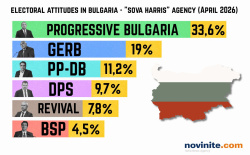
HOT: » Which party would you vote for (if you could) in the upcoming snap vote in Bulgaria on April 19?
 Send to Kindle
 @evroto.bg
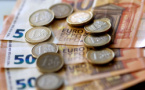
The Ministry of Internal Affairs has issued guidance aimed at preventing fraud linked to the circulation of euro banknotes. Citizens are encouraged to familiarize themselves with the security features of the new currency, while merchants are advised to use specialized devices to detect counterfeit money. In cases of suspicion, people should immediately contact emergency number 112 or their nearest police station.
Zlatka Padinkova, head of the Fraud Sector at the General Directorate of the National Police, urged citizens to rely exclusively on official exchange offices and banks and to be cautious of any unofficial offers connected to the euro. She stressed that any proposal involving a more favorable exchange rate than the officially fixed one should be treated as a scam.
According to Padinkova, there are currently no reports of fraud attempts related to pensions. However, she warned that once pensions begin to be paid in euros, criminal activity in this area may increase. She noted that law enforcement expects fraudsters to become more active during the initial period of the currency transition.
Padinkova emphasized that vigilance is required everywhere, regardless of whether people live in large cities or small towns. She warned citizens never to accept an exchange rate different from the official one, underlining that promises of better rates are inherently deceptive. She also reminded the public that currency exchange will be free of charge for the first six months at banks and post offices.
She clarified that legitimate exchanges are carried out only inside bank branches and post offices, not in their surrounding areas. Citizens were also cautioned against trusting phone calls, text messages or emails advertising preferential exchange conditions.
Another key risk highlighted by Padinkova concerns counterfeit banknotes. During the current period, both the lev and the euro are in circulation, which increases the likelihood of confusion. She warned that euro and lev coins can appear similar, and people should carefully check any change they receive, as counterfeit notes may also be passed on during transactions.
If a counterfeit banknote is suspected, citizens should immediately alert the authorities by calling 112 or contacting the nearest district police office. Padinkova advised people not to rush when handling money and to avoid sharing cash or personal information. She stressed that exchanges conducted at the Central Bank are free of charge and not subject to limits.
Padinkova also made it clear that there are no official mobile teams visiting homes in small settlements to assist elderly people with currency exchange. Any such claims should be treated as fraudulent.
She recommended checking banknotes using the European Central Bank’s “touch, look, tilt” method and encouraged wider use of bank cards for payments. Given that many people are not yet fully accustomed to recognizing euro banknotes, she advised limiting cash transactions where possible.
Padinkova reiterated that no legitimate institution will ever request money, personal data or banking details by phone. She noted that in recent months, fraudsters have impersonated employees of fintech companies, asking for card information or access codes under the pretext of assisting with currency conversion. She added that criminals often use spoofed phone numbers and messaging applications to appear credible, making extra caution essential.

Bulgaria's only oil refinery, Lukoil Neftochim Burgas, processed Russian crude for most of its post-Soviet history. Since March 2024, that has been banned by law

Energy expert Martin Vladimirov from the Center for the Study of Democracy has warned that fuel prices in Bulgaria have not yet reached their peak, adding that the country is gradually converging with average EU levels.

Former Defense Minister Prof. Todor Tagarev has commented on Bulgaria’s military aviation situation, noting concerns about the condition of the country’s current fighter fleet and the pace at which new aircraft are being integrated.

Healthcare costs in Bulgaria are rising at a significantly faster pace than overall inflation, with price growth in the sector in 2026 roughly twice the national average compared to 2025

Around half a million Bulgarians chose to spend Easter inside the country, while roughly 120,000 traveled abroad

Bulgargaz has submitted a proposal to the Energy and Water Regulatory Commission (EWRC) suggesting a natural gas price of €35.98 per megawatt hour (MWh) for May
The Bulgarian National Bank (BNB) has decided to increase the countercyclical capital buffer to 2.25%, in a move aimed at easing pressure on the rapidly growing housing credit market and strengthening the resilience of the banking system.
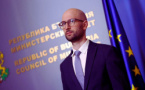
The Ministry of Finance has released a broad public dataset covering more than 7,000 public procurement contracts with a combined value exceeding 30 billion euros
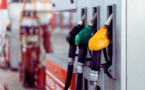
Caretaker Finance Minister Georgi Klisurski said he expects fuel prices at gas stations to ease in the coming period, pointing to a sharp decline in international oil markets
Bulgaria’s new government borrowing for 2026 has surpassed the 1 billion euro mark following the latest successful auction of state securities, according to data cited from the Bulgarian National Bank

Bulgaria recorded only a modest and one-off increase in inflation following the adoption of the euro on January 1, with the effect estimated at between 0.3 and 0.4 percentage points
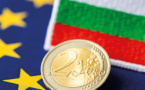
Data released by the Ministry of Finance, covering budget execution for February 2026 and preliminary estimates for March 2026, indicate a marked deterioration in Bulgaria’s fiscal position

Aniventure Comic Con Returns to Bulgaria with Star Guest Christopher Judge!
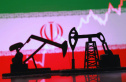
Global Fuel Shock: Oil Jumps Over 40% Since Iran War Began