The Power of Knowledge Lies in Its Use
Dr. Boyko Takov: Analytical and empirical results from ongoing projects constitute a solid information base
Business | April 9, 2026, Thursday // 18:21
HOT: » Which party would you vote for (if you could) in the upcoming snap vote in Bulgaria on April 19?
 Send to Kindle
 Photo: Stella Ivanova
In 2025, Bulgaria recorded a markedly positive migration balance, with arrivals significantly outnumbering departures. Data from the National Statistical Institute, cited by Nova TV, show that around 13,000 people left the country during the year, most of them heading to Germany and the United Kingdom. Over the same period, more than 52,000 people settled in Bulgaria.
Of those who moved to the country, nearly 18,000 were Bulgarian citizens returning from abroad. A further 28,000 newcomers were citizens of countries outside the European Union, while about 7,000 came from other EU member states, indicating that migration to Bulgaria is driven by both return migration and inflows from third countries.
Demographic indicators also place Bulgaria in a distinct position within the European Union. According to the latest Eurostat estimates, the country currently has the highest fertility rate among EU member states. The total fertility rate stands at 1.81 children per woman, compared to an EU average of 1.38. At regional level, the highest fertility rate is observed in Sliven, while the lowest is recorded in Smolyan.
Bulgaria also ranks first in the EU for the youngest average age of women at childbirth. Women in the country give birth at just over 28 years on average, while the EU average exceeds 31 years. In Ireland, for example, the average age of mothers at childbirth is over 33.
At the same time, mortality trends remain unfavorable. While deaths are increasing across the European Union, with an average mortality rate of 10.8 per 1,000 people, Bulgaria’s rate is significantly higher at 15.7 per 1,000. Life expectancy in Bulgaria is also the lowest among EU countries.
Economic data show continued income growth. For the most recently reported period, July to September, the average gross monthly salary reached 2,549 leva, which is roughly 1,303 euros. Wages in the public sector were about 150 leva, or approximately 77 euros, higher than those in the private sector. On an annual basis, average pay increased by 12 percent.
The highest salaries are found in several key sectors. Average monthly pay exceeds 3,500 leva, about 1,789 euros, in Energy Production and Distribution, Finance and Insurance, and Information Creation and Dissemination. In the latter sector, average wages surpass 5,500 leva, equivalent to around 2,813 euros.
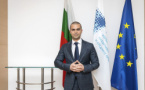
Dr. Boyko Takov: Analytical and empirical results from ongoing projects constitute a solid information base
The European Public Prosecutor’s Office (EPPO) has carried out a series of coordinated investigative actions across several countries, including Bulgaria and Romania, as part of a probe into suspected large-scale fraud involving EU funds
Holiday weather conditions are expected to remain mixed across Bulgaria, with alternating periods of sunshine and rain showers, according to the forecast
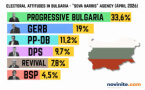
A new survey by the “Sova Harris” agency indicates that six political formations would enter the next Bulgarian National Assembly, based on data collected between April 2 and 6 among 800 respondents through standardized face-to-face interviews

Up to 90 percent of construction and renovation workers in Bulgaria are operating outside the legal framework, according to entrepreneur Lozan Lozanov, who raised concerns about the lack of regulation in construction and installation services
The Ministry of Finance has released a broad public dataset covering more than 7,000 public procurement contracts with a combined value exceeding 30 billion euros

The Bulgarian scientific research vessel “Sts. Cyril and Methodius” (NIC 421) has returned to Varna, docking at the Marine Station and marking the official end of the country’s 34th Antarctic expedition
Holiday weather conditions are expected to remain mixed across Bulgaria, with alternating periods of sunshine and rain showers, according to the forecast

The Bulgarian Orthodox Church has decided that no official delegation will travel to Jerusalem this year to receive the Holy Fire, citing the ongoing tensions in the Middle East

Plovdiv will host the International Street Arts Festival 6Fest from April 20 to 26, 2026, turning the city into an open-air stage featuring performers from 11 countries across three continents

The Easter holiday getaway has officially begun in Bulgaria, with traffic leaving Sofia surging as thousands of people set off for the long weekend

Holy Thursday marks one of the most significant days in Holy Week, as Christians reflect on the final moments before the crucifixion of Jesus Christ

Aniventure Comic Con Returns to Bulgaria with Star Guest Christopher Judge!
Global Fuel Shock: Oil Jumps Over 40% Since Iran War Began