Bulgaria Celebrates Vine and Wine Day
- Tweet
 Send to Kindle
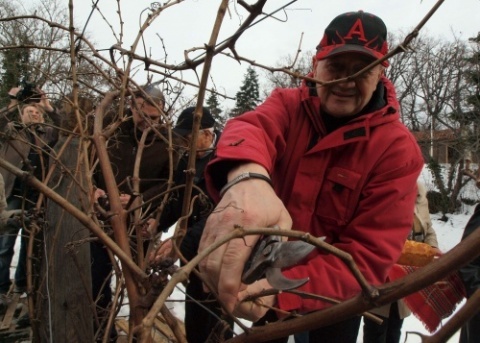 Tradition has it that on February 1 the men should set out to prune the vines while the women bake festive bread loaves and prepare roast chicken stuffed with rice. Photo by BGNES
The Bulgarian Orthodox Church honors on Wednesday, February 1, the Day of Saint Trifon, the patron of vine-growers, wine-producers and tavern-keepers.
The holiday is widely known in Bulgaria as Trifon Zarezan - from the Bulgarian verb "zariazvam" meaning to prune vines.
Saint Trifon was born in 225 AD in the village of Kossada in Phrygia in Asia Minor. His parents were righteous people, who, from very early age, thought him love and devotion to God. Their efforts soon proved successful because Trifon began accomplishing miracles since childhood. He became famous at the age of 17 when he cured the daughter of the Roman Emperor Gordian. Unfortunately, Gordian was succeeded by Decius, who prosecuted Christians, and in 250 AD Trifon was arrested, tortured and decapitated.
In Bulgaria, the day of Saint Trifon was initially celebrated on February 14. Under the Communist regime, the Holiday was largely known as the "Day of the Vine-Grower". In 1968, when the Bulgarian Orthodox Church introduced the Gregorian calendar, the Church began honoring Saint Trifon on February 1, while February 14 remained the vine-growers' Day.
Many Bulgarians still continue to celebrate Trifon Zarezan on February 14 - one of the very few holidays to be still honored according to the old calendar. In recent years, Trifon Zarezan coincides with Saint Valentine's Day - a holiday largely unknown in Bulgaria during the Communism, but acquiring greater and greater popularity.
Bulgarians celebrate Trifon Zarezan with folkloric rituals in vineyard villages throughout the country. The men set out to prune the vines while the women bake festive bread loaves and prepare roast chicken stuffed with rice. Each vine-grower leaves for the vineyard with the bread and the chicken in a new, colorful woven bag and with a vessel (buklitsa) filled with red wine. Before the pruning begins, men turn to the sun and make the sign of the cross three times. After the first three twigs are cut, they wash them with the red wine, holy water and wood ashes that they had kept since Christmas Eve. At the end of the day, everyone gathers together to eat, drink wine, sing and dance. The man who harvested most grapes in the year is appointed "King". He and his subjects must traditionally get drunk to ensure a good harvest the following year.
There are many different folklore versions of the way this Day is celebrated in different parts of the country as well as many different legends about who Trifon was. However, ethnographers are unanimous that the celebrations are rooted in the ancient Dionysus festivities, celebrating Dionysus - the God of Wine, who was known to have thought people everywhere he went how to grow vines and make wine. The celebrations were accompanied by rampant outdoor games and parties.

Plovdiv Becomes Open-Air Stage as 6Fest Brings Street Arts from 11 Countries
Plovdiv will host the International Street Arts Festival 6Fest from April 20 to 26, 2026, turning the city into an open-air stage featuring performers from 11 countries across three continents
Holy Thursday in Bulgaria: Egg Dyeing , Bread Making and Reflection on Christ’s Suffering
Holy Thursday marks one of the most significant days in Holy Week, as Christians reflect on the final moments before the crucifixion of Jesus Christ
Holy Week Begins in Bulgaria: Church Outlines the Final Days of Christ’s Life
Holy Week has begun, marking the final days of the earthly life of Jesus Christ, the Bulgarian Orthodox Church announced, outlining the sequence of services that will be held across the country
Palm Sunday (Tsvetnitsa) in Bulgaria: A Day of Names and Renewal
Tsvetnitsa, known in English as Palm Sunday, is one of the most widely celebrated spring holidays in Bulgaria
Lazarovden: A Look at One of Bulgaria’s Spring Traditions
Lazarovden (St. Lazarus Day) is one of Bulgaria’s most recognizable spring holidays, combining Christian meaning with long-standing folk customs
147 Years Since Sofia Was Chosen as Bulgaria’s Capital
A total of 147 years have passed since Sofia was officially designated as the capital of Bulgaria