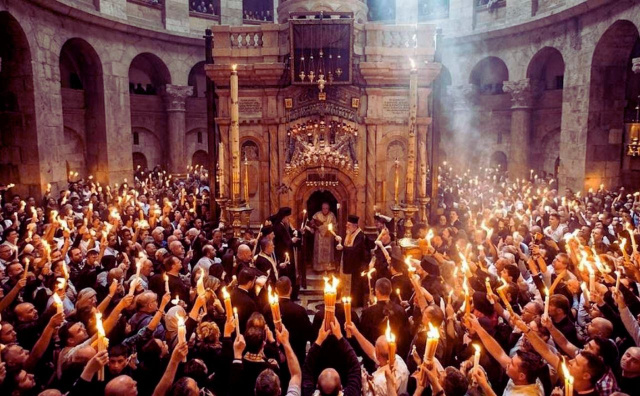
The Bulgarian Orthodox Church has decided that no official delegation will travel to Jerusalem this year to receive the Holy Fire, citing the ongoing tensions in the Middle East. The decision was confirmed by the Holy Synod, marking a continuation of last year’s absence from the traditional ceremony.
According to the Bulgarian Orthodox Church, the Holy Fire will still be present in the country despite the canceled visit. “We have the Holy Fire in the synodal chapel and in several other monasteries in the country, as well as in the ‘St. Nedelya’ temple,” the institution stated for BGNES.
The Holy Fire is traditionally linked to Holy Saturday at the Church of the Holy Sepulchre in Jerusalem, where Orthodox believers describe its appearance as a miraculous event associated with the Resurrection of Christ. The ritual is preceded by detailed preparations, including inspections of the chapel and sealing procedures carried out by representatives of different religious communities present at the site.
Customarily, the flame is received by the Orthodox Patriarch of Jerusalem and then distributed to other Christian denominations. The event draws thousands of pilgrims each year and remains one of the most significant rituals in Orthodox tradition.
Despite its religious importance, the ceremony is also surrounded by long-standing debate and interpretations, including belief-based warnings that if the Holy Fire were not to appear, it would signify apocalyptic consequences. These interpretations remain part of traditional narratives rather than official doctrine.
In practice, arrangements for transporting the flame continue to be organized through alternative channels. This year, the Holy Fire is expected to arrive in Greece via a government flight from Jerusalem, landing in Athens on Holy Saturday, according to reports cited by Kathimerini.
Greek authorities are reportedly preparing logistics for distribution across the country, with domestic airline Sky Express expected to transport the flame from Athens to multiple destinations, including Alexandroupolis, Heraklion, Corfu, Chania, Mytilene, Rhodes, and Santorini.
Greek officials have also indicated that they are monitoring developments in the region closely and are considering different transport options to ensure the arrival of the Holy Fire despite regional instability.