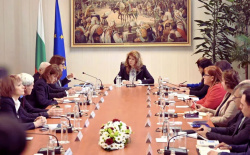
President Iliana Yotova has vetoed amendments to the Electoral Code that sought to restrict the number of polling stations for Bulgarians living outside the European Union. The changes, passed by parliament on February 5, 2026, were returned to the National Assembly for further discussion, with Yotova emphasizing that all Bulgarian citizens, regardless of location, are entitled to the full exercise of their constitutional rights, including the right to vote.
Under the proposed amendments, a maximum of 20 polling stations could be established in non-EU countries, irrespective of the number of citizens requesting them. Yotova argued that this limit threatens the principle of universality of suffrage enshrined in Article 10 of the Constitution and could prevent citizens from fulfilling their compulsory voting obligations under the Electoral Code. She also cited Constitutional Court rulings confirming that the state must ensure conditions for the free and unobstructed exercise of voting rights, and that procedural barriers that hinder participation are unconstitutional.
The president noted that the proposed limit would disproportionately affect Bulgarians living in distant non-EU countries, where travel to a polling station may be difficult or impossible given the number of voters and logistical constraints. She warned that such restrictions would create unequal conditions compared with citizens residing in EU member states, who benefit from a more flexible system that allows polling stations to be established based on previous turnout or the number of applications submitted.
Yotova highlighted that these amendments violate the constitutional principle of equality by placing Bulgarian citizens outside the EU at a disadvantage. She stressed that the Constitution guarantees equal treatment for all citizens, and artificially restricting access to polling stations undermines this principle. In her view, the changes also risk reducing voter turnout, particularly among overseas citizens, which could negatively impact the legitimacy of elected bodies.
The president criticized the timing and process of the amendments, noting that implementing such significant changes immediately before elections, without extensive public consultation or parliamentary debate, undermines the predictability and stability of electoral legislation. She stressed that voting rules should be transparent, consistent, and secure to maintain public confidence in the democratic process.
Yotova concluded that the amendments contradict Bulgaria’s commitments under EU and Council of Europe law, which require the broadest possible participation in free and fair elections. By imposing artificial restrictions, the changes not only limit the constitutional right to vote but also risk eroding public trust in the electoral system. For these reasons, she returned §1, §2, and §3 of the Law on Amendments to the Electoral Code to the National Assembly for reconsideration, urging lawmakers to ensure equal and unrestricted voting access for all Bulgarian citizens, wherever they reside.


 President Iliana Yotova