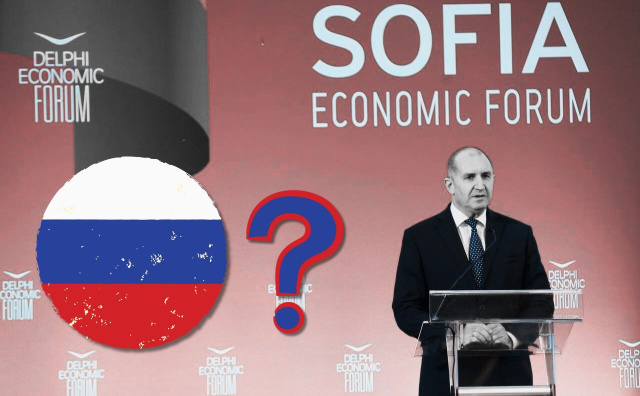
Rumen Radev’s first public appearance after formally stepping onto the political field took place at the Sofia Economic Forum, where his remarks outlined positions that are likely to shape his forthcoming election campaign. Although parties, particularly those linked to the WCC-DB coalition, remain cautious and have avoided taking a clear stance on his future political project, Radev’s views have been largely consistent throughout his nearly decade-long political career and were again clearly articulated in his latest statements.
Speaking at the forum, Radev questioned the arguments of those advocating eurozone membership, saying supporters had created expectations of a “golden rain” of investments. According to him, such guarantees were never realistic. The eurozone, he argued, merely provides a framework and opportunities, while the actual benefits depend on whether a country can make effective use of them. At the same time, he warned that Bulgaria must deal with what he described as the negative social and economic effects of an unprepared and rushed entry into the eurozone, while also making use of the opportunities membership offers. This assessment contrasts with the fact that Bulgaria joined the eurozone almost two decades after entering the EU, a timeline that critics say can hardly be described as hasty. Radev nevertheless emphasized that eurozone membership should not be treated as a strategic objective in itself, but rather as a tool for achieving faster convergence with average European living standards through accelerated economic growth.
Further reading: NATO Pilot, Putin Sympathizer, or Something Else? Who Is Rumen Radev and Why Did He Just Blow Up Bulgarian Politics
Radev also devoted significant attention to structural problems within Bulgaria. He said the country still faces serious work before achieving real integration into the EU. This includes removing oligarchic influence from power, halting the flow of public funds to entrenched interests, establishing genuine rule of law, ensuring an effective separation of powers and an independent judiciary, restoring transparency and accountability in governance, and freeing business from what he described as racketeering. According to Radev, there is sufficient public demand for change to transform these goals into concrete reforms that would unlock the potential of Bulgarian companies and create a healthier economic environment.
In his remarks, Radev criticized the current economic model, arguing that reliance on household consumption, rapid credit expansion and rising government debt is reaching its limits. He pointed to declining exports and falling industrial output as indicators that this model is no longer sustainable. Attracting investment, he said, would require targeted efforts to ensure capital brings high added value and contributes to restructuring the economy, rather than relying on optimistic expectations.
On the international stage, Radev welcomed elements of the new US National Security Strategy, which describes Europe as facing not only economic difficulties but also a democratic crisis, cultural depersonalization and demographic decline. He echoed recommendations in the document calling for stronger national sovereignty, protection of identity, reduced regulation, tougher action against illegal migration, restored media freedom and what he termed a more realistic approach toward Ukraine and Russia. He also argued that Europe must adapt quickly to global changes, noting that in a world shaped by wars and ideological confrontation, economic considerations are increasingly subordinated to sanctions, political alignment and protectionism, while free trade is in retreat.
Radev said Europe’s leaders face the challenge of responding to a global agenda increasingly shaped by the United States, China and Russia, warning that cheap energy, labor and capital are no longer guaranteed for the continent. He suggested that the strategy of seeking peace through strength toward Russia is becoming detached from reality and risks deepening Ukraine’s economic, energy and demographic crisis while creating additional problems for Europe itself. In his view, geopolitical and ideological considerations have begun to dominate decisions on energy and raw material supply, pushing traditional market principles into the background.
In one of his more controversial comments, Radev cited Russia as an example of industrial mobilization, urging European leaders to focus on protecting competitiveness and preventing deindustrialization by prioritizing economic interests over ideological goals. Critics argue this comparison overlooks Russia’s current economic difficulties, including weak growth prospects, heavy reliance on military spending and pressure from higher taxes and declining energy production.
Throughout his speech and his subsequent Facebook post, Radev returned repeatedly to two main priorities: mitigating the negative consequences of eurozone accession as he sees them, and making full use of the advantages it provides. He framed these goals as part of a broader effort to restore statehood, strengthen democracy and raise living standards, presenting the eurozone not as an end in itself but as one instrument among many for achieving those outcomes.