Easter Monday in Bulgaria: Tradition and Family Visits
Orthodox Easter Monday is the day following Easter Sunday and is observed across Bulgaria as part of the wider Easter celebration within the Orthodox Christian tradition
HOT: » Which party would you vote for (if you could) in the upcoming snap vote in Bulgaria on April 19?
 Send to Kindle
This week holds the promise of significant developments in Bulgaria's political arena, as discussions continue regarding the country's future leadership. Prime Minister Nikolai Denkov, supported by his party coalition "We Continuing the Change-Democratic Bulgaria" (WCC-DB), will reisgn on March 6, prompting speculation about the next steps. With Denkov's resignation, the entire government follows suit, setting the stage for what some are dubbing "constitutional roulette," where the president must transfer the mandate to the largest parliamentary force - in this case, GERB.
Yet, consensus between WCC-DB and GERB, the main actors in this political drama, remains elusive. Recent weeks have seen both sides issue ultimatums and communicate primarily through the media.
Positions and Demands in Focus
The WCC-DB coalition unveiled a "Memorandum" on February 20, outlining a decision-making mechanism and shared responsibilities between WCC-DB and GERB, excluding DPS. However, GERB's leader, Boyko Borissov, dismissed this, advocating instead for a "coalition agreement" and demanding 50 percent of ministerial seats. While Borissov claims his proposal incorporates elements of the memorandum, he has set a deadline for WCC-DB's response by March 8.
In response, Prime Minister Denkov expressed doubts about reaching a resolution within such a short timeframe. Meanwhile, WCC-DB leaders emphasized the urgent need to establish a new Commission for Combating Corruption (CPC), attributing delays to GERB's inaction.
Contingency Plans and Speculation
Amidst the deadlock between parties, speculation abounds regarding alternative strategies. The potential collapse within the "Vazrazhdane" party and ongoing discord within the "assembly" (that is GERB + WCC-DB) have fueled rumors of Borissov's Plan B - forming a majority within the current parliament. The presence of representatives of GERB and BPS at the DPS congress also contributed to these speculations, with Dragomir Stoynev (BSP) even talking about the fact that the state should be governed by the systemic parties. However, an official "meeting" with Kostadin Kostadinov's party ("Vazrazhdane") seems impossible - especially since he and his people ended up in Moscow at a meeting of "United Russia". However, "Vazrazhdane" and "There Is Such a People" have proven to be helpful to GERB and DPS formations when they do not have a majority with WCC-DB.
Another option under consideration is the prospect of concurrent parliamentary elections alongside the European elections scheduled for June 9. Despite these deliberations, polling data suggests minimal shifts in power dynamics.
President Rumen Radev's role in navigating the crisis remains uncertain, as amendments to the Constitution have limited his authority. Radev's remarks indicate a looming constitutional crisis, with his signature essential for formalizing ministerial appointments. Amidst these uncertainties, Radev has sought clarity from the Constitutional Court, underscoring the gravity of the situation.
As Bulgaria stands at the precipice of political transformation, the coming days hold the promise of resolution or further escalation in the ongoing saga of governance. With Prime Minister Denkov's resignation catalyzing a flurry of negotiations and brinkmanship, the nation teeters on the brink of uncertainty. As stakeholders grapple with divergent agendas and strategic calculations, the path forward remains fraught with challenges and complexities. Yet, amidst the turbulence of political maneuvering, one thing is certain: Bulgaria's future hangs in the balance.
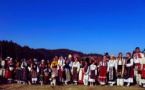
Orthodox Easter Monday is the day following Easter Sunday and is observed across Bulgaria as part of the wider Easter celebration within the Orthodox Christian tradition

Industrial output in Bulgaria posted a modest monthly increase in February 2026, but continued to decline sharply on an annual basis, according to preliminary, seasonally adjusted data from the National Statistical Institute.
The president of the Confederation of Bulgarian Trade Unions, Plamen Dimitrov, has warned that inflation in Bulgaria is likely to exceed earlier projections, even if fuel prices begin to decline

The introduction of the euro in Bulgaria has so far produced only a limited and largely one-off effect on consumer prices, according to an analysis by the European Central Bank

Easter is the most important religious holiday in the Orthodox Christian calendar and is widely celebrated across Bulgaria. It marks the resurrection of Jesus Christ and follows the completion of Holy Week, which includes Good Friday and Holy Saturday

Holy Saturday, known in Bulgaria as Lazarus Saturday’s continuation of the Easter cycle, is a quiet but deeply symbolic day in the Orthodox Christian calendar
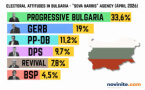
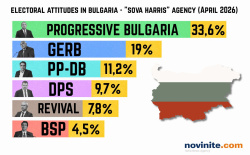
A new survey by the “Sova Harris” agency indicates that six political formations would enter the next Bulgarian National Assembly, based on data collected between April 2 and 6 among 800 respondents through standardized face-to-face interviews

Bulgaria is bracing for an increase in disinformation activity in the run-up to the parliamentary elections on April 19, with authorities warning of coordinated attempts to influence voters and destabilize public trust

The Prosecutorial College of the Supreme Judicial Council has declined to remove Borislav Sarafov from his position as Acting Prosecutor General, despite calls from the Justice Ministry to act following a recent Constitutional Court ruling

The government has decided to withdraw all three Bulgarian nominations for the position of European Prosecutor, effectively restarting the procedure after identifying serious flaws in the initial selection process
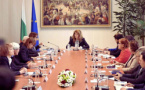
President Iliana Yotova convened a meeting of institutions responsible for the conduct of the early parliamentary elections on April 19, with a focus on assessing preparedness and ensuring that every vote is properly safeguarded
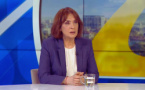
Bulgaria’s caretaker Foreign Minister Nadezhda Neynsky said the announcement of a two-week ceasefire between the United States and Iran brought a sense of relief after weeks of escalating tensions in the Middle East

Aniventure Comic Con Returns to Bulgaria with Star Guest Christopher Judge!
Global Fuel Shock: Oil Jumps Over 40% Since Iran War Began