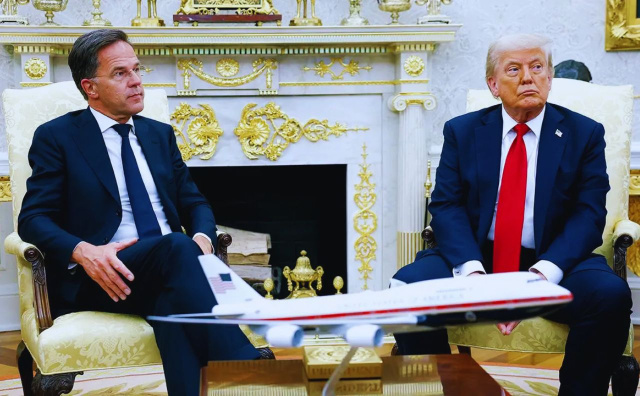
US President Donald Trump has sharply criticized NATO allies over what he described as their unwillingness to support Washington during the war with Iran, following a two-hour meeting with Secretary-General Mark Rutte at the White House. Writing on Truth Social shortly after the talks, Trump said in capital letters that “NATO wasn’t there when we needed them, and they won’t be there if we need them again,” intensifying concerns about tensions within the alliance.
The remarks came amid broader criticism from the White House. Spokesperson Karoline Leavitt said some allies had “turned their backs on the American people,” who contribute heavily to their defense, adding that Trump viewed the situation as a failed test. “They were tested, and they failed,” she quoted the president as saying ahead of the meeting, which she described as expected to be “very frank and candid.”
Frictions have been fueled by the refusal of several NATO members to allow US military aircraft to use their airspace or to contribute naval support in efforts to reopen the Strait of Hormuz, a key global energy route effectively shut by Iran. The dispute has revived speculation that Trump could again consider pulling the United States out of the alliance, which he has previously dismissed as a “paper tiger.”
After the meeting, Trump also reignited controversy by revisiting his earlier remarks about Greenland, suggesting renewed interest in the territory, which belongs to NATO member Denmark. In a post, he referred to it as “that big, poorly run, piece of ice!!!”, echoing past statements that had unsettled allies.
Rutte, often seen as adept at maintaining a working relationship with Trump, acknowledged the US president’s frustration but sought to present a more balanced picture. He said their discussions were “very frank” and “very open,” while noting that many European countries had in fact provided logistical and operational support. “The large majority of European nations have been helpful, with basing, with logistics, with overflights,” he said, adding that US actions against Iran were possible because allies “lived up to those commitments.”
At the same time, Rutte conceded that not all countries had contributed equally, saying he understood Trump’s disappointment but stressing that the situation was “a nuanced picture.” He also dismissed suggestions that NATO members broadly viewed the war as unlawful, arguing instead that there was significant backing for efforts to weaken Iran’s nuclear and missile capabilities. Prolonged diplomacy, he warned, risked creating “a North Korean moment” in which negotiations continue until it is too late.
The NATO chief avoided directly addressing whether Trump had threatened to withdraw the US from the alliance, despite repeated questions. Reports have also emerged that Washington is considering relocating troops from countries seen as uncooperative during the conflict, although such a move would fall short of a full withdrawal, which would require congressional approval.
Founded in 1949 as a counterweight to the Soviet Union, NATO remains central to Western security and has invoked its collective defense clause only once, after the September 11 attacks. However, the latest dispute has raised fresh questions about its cohesion, particularly as it remains unclear what specific role the US expected the alliance to play in the Middle East conflict.