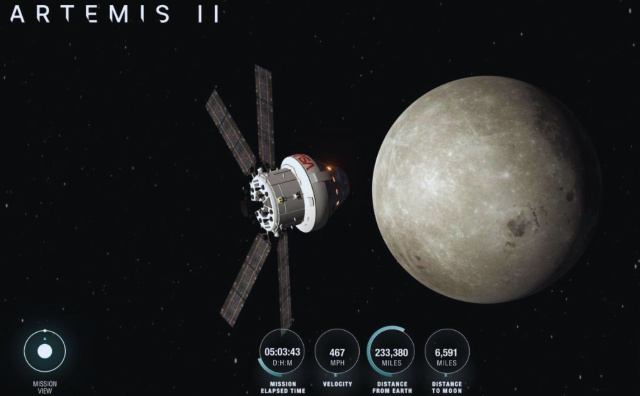
For the first time in over half a century, astronauts are once again traveling through lunar space, as NASA’s Artemis 2 mission continues its historic journey around the Moon.
The mission’s Orion spacecraft entered the Moon’s sphere of influence at 12:37 a.m. EDT on April 6, when it was located about 62,764 km from the lunar surface and roughly 373,368 km from Earth, according to NASA’s live transmission. This is the region where the Moon’s gravity becomes stronger than Earth’s pull on the spacecraft.
On board are NASA astronauts Reid Wiseman, Victor Glover and Christina Koch, together with Canadian Space Agency astronaut Jeremy Hansen. They are the first humans to cross into this lunar boundary since the Apollo 17 mission in December 1972, marking a return to deep-space human exploration after more than 50 years.
Artemis 2 is not designed to land on the Moon or even enter lunar orbit. Instead, Orion will conduct a close flyby of the Moon’s far side later in the mission. During this pass, the spacecraft is expected to reach its greatest distance from Earth, surpassing the Apollo 13 record of 400,171 km. NASA has stated that Artemis 2 will peak at around 406,773 km from Earth during the flyby, which is expected to occur around 7 p.m. EDT.
Beyond setting distance records, the crew will carry out observations of the lunar surface, collecting data intended to improve understanding of the Moon’s terrain and geological features. The astronauts will also experience a total solar eclipse from their vantage point in space, an event not visible from Earth during this phase of the mission. After completing the flyby, lunar gravity will help redirect Orion back toward Earth, with the mission scheduled to conclude on April 10 after a 10-day flight, ending in a parachute-assisted splashdown off the coast of San Diego.