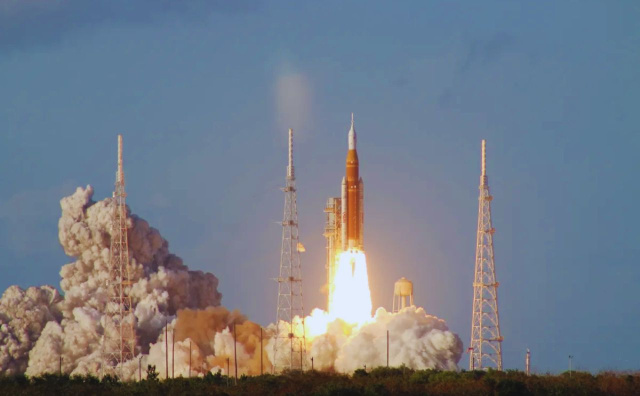
NASA successfully launched its Artemis II mission, with the spacecraft now circling Earth after a powerful and highly anticipated liftoff. The rocket’s ascent was described as an intense physical experience, with the force of launch clearly felt, while astronaut Reid Wiseman remarked on the “amazing” view as the crew climbed to altitude. The capsule will remain in orbit for about 24 hours as astronauts carry out a series of system checks before a final decision is made on whether to proceed toward the Moon. According to officials, the crew are safe, stable and in good condition. Although the mission will not include a landing, it is expected to loop around the Moon and could take humans farther from Earth than ever before during its 10-day duration.
The launch itself was not without complications. Technical concerns appeared even before liftoff, and once in orbit, engineers began working through a number of minor issues. Among them was an unexpected problem with the spacecraft’s waste-management system, where irregular sensor readings required troubleshooting. Mission specialist Christina Koch worked on resolving the issue, and later confirmation from mission control indicated the system was functioning again, with only precautionary guidance issued. Additional small glitches included a valve between water tanks that had to be reset after likely shifting during launch, as well as a repeat of a minor electronic disruption previously seen during Artemis I. None of these were considered critical, but they highlighted the experimental nature of the mission.
Inside mission control, the operation reflects both continuity and change. The modern setup, far removed from the bulky consoles of earlier decades, still follows the framework first developed by Christopher Kraft during the early US space program. Flight directors, including Fiona Antkowiak, continue to oversee every stage, maintaining the same core principles that guided historic missions, despite the updated technology.
While in orbit, the crew is deliberately pushing the spacecraft to its limits to verify its readiness for deep space travel. Systems are being tested under varying conditions, including computer mode changes, communication handovers between ground stations and satellites, and adjustments to cabin movement to assess life-support performance. Engineers are also monitoring thruster activity and the response of the European-built service module. These checks are designed to determine whether the spacecraft is fully prepared for the critical burn that would send it toward the Moon. If any serious concern arises, the mission could be cut short, with the crew returning directly to Earth.
Operational procedures are continuing alongside technical evaluations. Astronauts are following a structured rest schedule, splitting sleep into two phases around key manoeuvres such as the “perigee raise burn,” which will stabilize the orbit for a potential return trajectory. At the same time, they are conducting proximity operations, guiding the Orion capsule away from and back toward the rocket’s upper stage. This exercise is intended to simulate future docking scenarios and allows the crew to practise both automated and manual control in close-range flight.
Despite the technical checks and minor malfunctions, the mission remains on track. The coming hours will be decisive, as NASA evaluates whether all systems are performing reliably enough to commit the crew to a journey far beyond Earth orbit.
The crew of Artemis II has set a new milestone in human spaceflight, traveling farther from Earth than any astronauts before them. During their journey
For the first time in over half a century, astronauts are once again traveling through lunar space, as NASA’s Artemis 2 mission continues its historic journey around the Moon.
Bulgarian astronomers have identified a new super-Earth exoplanet orbiting the star GJ 1137, with their findings published in the respected journal Astronomy & Astrophysics.
The prominent Bulgarian businessman and globally renowned PR Expert Maxim Behar and his wife Veneta will depart for the United States on February 12, where they will undergo an intensive training course at the NASA U.S. Space & Rocket Center in Huntsvill
The China National Space Administration (CNSA) on Wednesday unveiled a remarkable image of the Tianwen-2 probe alongside Earth, captured during its deep-space journey
The caretaker government has approved a decision endorsing the Partnership Agreement between the European Union and its Member States and the Mercosur bloc
Several Gulf states have reported missile and drone strikes on their territories just hours after the United States and Iran announced a two-week ceasefire agreement, raising fresh questions about whether the truce is holding on the ground
US Vice President JD Vance launched a sharp attack on the European Union during a visit to Budapest, accusing Brussels of interfering in Hungary’s election just days before a closely contested vote that could reshape the country’s political landscape
Global markets reacted sharply after US President Donald Trump stepped back from imminent military action against Iran, instead tying a suspension of strikes to Tehran’s agreement to a temporary ceasefire and the reopening of the Strait of Hormuz
On the 40th day of the war, a tentative pause in hostilities has been announced, as US President Donald Trump said Washington would suspend its attacks after Iran agreed to a two-week ceasefire
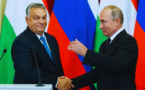
A leaked transcript of a phone call between Hungarian Prime Minister Viktor Orban and Russian President Vladimir Putin shows Orban offering extensive support to Moscow and describing himself as ready to help “in any way” in relation to the war in Ukraine
Aniventure Comic Con Returns to Bulgaria with Star Guest Christopher Judge!
Global Fuel Shock: Oil Jumps Over 40% Since Iran War Began
Bulgaria news
Novinite.com (Sofia News Agency - www.sofianewsagency.com) is unique with being a real time news provider in English that informs its readers about the latest Bulgarian news. The editorial staff also publishes a daily online newspaper "Sofia Morning News."
Novinite.com (Sofia News Agency - www.sofianewsagency.com) and Sofia Morning News publish the latest economic, political and cultural news that take place in Bulgaria.
Foreign media analysis on Bulgaria and World News in Brief are also part of the web site and the online newspaper.
News Bulgaria