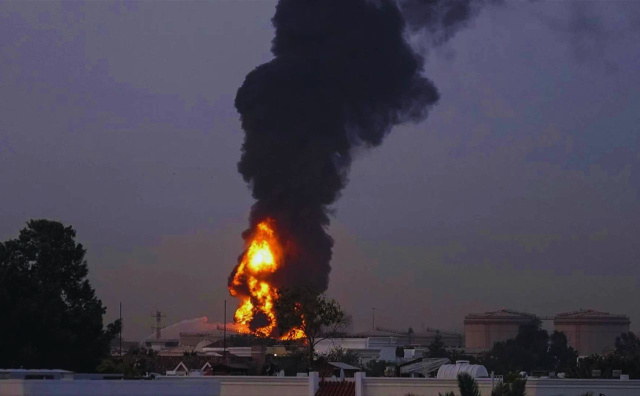
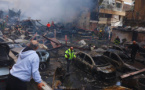
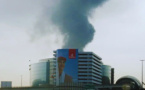
Airstrikes carried out by the United States and Israel have struck key gas infrastructure in southern Iran, targeting facilities linked to the South Pars field near the city of Asaluyeh. Iranian media reported that gas storage tanks and processing units were hit, forcing at least two refineries with a combined capacity of around 100 million cubic meters per day to halt operations. Explosions were heard across multiple sites, including facilities connected to phases three, four, five, and six of the massive offshore field. Workers were evacuated, while emergency teams were deployed to contain fires caused by the strikes. Authorities have not yet provided details on casualties or the full scale of the damage.
State sources said four gas treatment plants processing sour gas from the same phases were taken offline to prevent the spread of fire, a move that is also expected to reduce output from connected offshore platforms. The South Pars field, jointly shared with Qatar and known as the North Field on the Qatari side, is the world’s largest natural gas reserve and accounts for up to three-quarters of Iran’s gas production. It also plays a crucial role in supplying feedstock for the country’s petrochemical and gasoline industries. The attack is seen as particularly significant, with estimates suggesting it may have disrupted roughly one-fifth of Iran’s gas processing capacity.
Markets reacted quickly to the developments, with European gas benchmarks and Brent crude prices rising shortly after news of the strikes. Analysts warn that continued targeting of Iran’s energy infrastructure could put at risk up to 3.4 million barrels per day of crude production and around 1.5 million barrels per day of exports. The latest incident marks the second time since the start of the war that downstream facilities have been hit, following earlier strikes on oil depots and a refinery near Tehran, where damage was reported but not fully assessed.
The escalation has drawn international concern. Qatar condemned the strikes as dangerous and irresponsible, warning that attacks on energy infrastructure threaten both regional stability and global energy security. Russia also criticized the operation, particularly due to its proximity to the Bushehr nuclear facility, urging an end to strikes on Iranian nuclear-related sites. Iranian officials previously told the International Atomic Energy Agency that earlier attacks near Bushehr had caused no injuries or damage.
The strikes are part of a broader US-Israeli offensive that began on February 28 and has resulted in around 1,300 deaths, including Iran’s Supreme Leader Ali Khamenei. Tehran has responded with drone and missile attacks targeting Israel as well as countries hosting US military assets, including Jordan, Iraq, and several Gulf states, causing damage and disrupting aviation and global markets. Israeli sources indicate the latest strike represents a further escalation, with expectations that Iran may retaliate by targeting energy infrastructure in Israel and across the region.