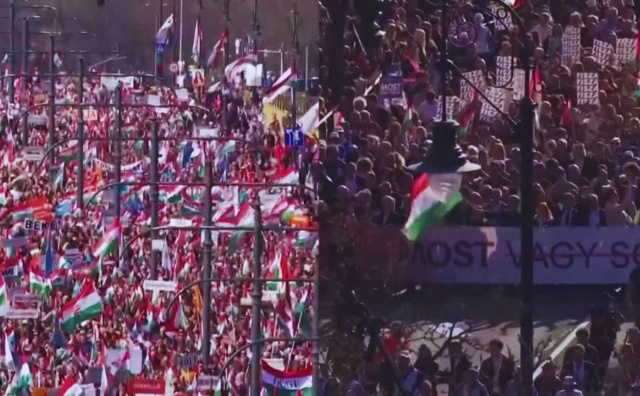
Hungary’s political divide was on full display in Budapest on March 15, as rival camps mobilized hundreds of thousands of supporters during the country’s national holiday, just weeks before a parliamentary election that could reshape the country’s political direction. Prime Minister Viktor Orban and opposition leader Péter Magyar used the anniversary of the 1848 Hungarian Revolution to rally supporters and present competing visions for the country ahead of the April 12 vote.
The election is widely seen as one of the most challenging contests Orban has faced in his 16 years in power. After more than a decade and a half dominated by his nationalist Fidesz party, the Hungarian leader is confronting growing public dissatisfaction fueled by economic stagnation, a sharp rise in the cost of living and corruption allegations. At the same time, Magyar’s relatively new Tisza party has rapidly gained support and is now viewed by many voters as a credible alternative.
Recent opinion polls generally show Tisza ahead, in some cases by about ten percentage points, though Fidesz has pointed to surveys suggesting it remains on track to win. Opposition figures argue that many of those polls have been conducted by institutions with personal or financial links to the ruling party. Despite the uncertainty, both sides are treating the campaign’s final weeks as decisive.
Orban used his rally in Budapest’s Kossuth Square near the parliament building to frame the election as a choice between peace and war. He warned supporters that the opposition could drag Hungary into the war in neighboring Ukraine, a claim that Magyar’s camp strongly rejects. The prime minister told supporters that Hungary must avoid becoming involved in the conflict and insisted that Hungarian soldiers would not fight in Ukraine.
“Our sons will not die for Ukraine, but will live for Hungary,” Orban declared, addressing a crowd gathered for the pro-government “Peace March.” The Hungarian leader also accused Brussels of attempting to exert outside influence over Hungary’s politics and said voters should resist what he described as foreign pressure.
Orban has long clashed with the European Union on a range of issues, including rule-of-law concerns and Hungary’s stance toward Ukraine. Unlike most EU governments, he has maintained comparatively cordial relations with Moscow, refused to send weapons to Kyiv and argued that Ukraine should not be fast-tracked into EU membership.
At the rally, Orban dismissed polls suggesting his party is trailing. Instead, he urged supporters to deliver an even stronger result than the landslide victory Fidesz achieved in the 2022 election. According to him, the next government will face historic responsibilities and the vote should therefore produce what he called a historic victory.
The Hungarian prime minister also used the moment to criticize Ukraine directly, referencing President Volodymyr Zelensky and recent tensions between the two countries. Budapest’s relationship with Kyiv has deteriorated in recent months, partly because of disputes over the Druzhba oil pipeline that supplies Russian crude to Hungary and Slovakia via Ukraine.
The pipeline has been offline since late January after a Russian strike in western Ukraine, according to Kyiv. Hungary and Slovakia have accused Ukraine of deliberately restricting oil transit for political reasons and demanded an inspection of the pipeline. In response, Orban blocked the European Union’s 20th sanctions package against Russia and delayed approval of a proposed €90 billion loan to Kyiv.
Hungary’s reliance on Russian energy remains a key factor in the government’s policy. As a landlocked country, Hungary depends heavily on imported oil and gas from Russia, and that dependence has only deepened since the start of the full-scale war in Ukraine.
Supporters attending the Fidesz rally echoed many of Orban’s arguments. One young participant said he feared the European Union and NATO were preparing for a broader war with Russia and argued that Hungary was not equipped for such a conflict. Another supporter said maintaining good relations with Moscow was unavoidable due to Hungary’s energy needs.
Some government supporters also expressed concern that a change of leadership could draw the country closer to Ukraine’s war effort. One attendee said she feared Hungarian soldiers might be sent to the Ukrainian front if Orban were defeated in the election.
The opposition gathering took place at the opposite end of the city, where large crowds filled an avenue stretching toward Heroes’ Square. Tisza supporters marched from Deák Ferenc Square to the monument in what organizers described as the National Rally for Change.
Magyar presented the election as a turning point for Hungary’s domestic future, focusing his message on corruption, economic stagnation and the country’s strained relations with the European Union. Addressing the crowd, he argued that Hungary had become increasingly isolated during Orban’s time in power and pledged to restore closer ties with European partners.
“On April 12, we will achieve a victory so great it will be visible not only from the Moon, but from the Kremlin as well,” Magyar told supporters.
The opposition leader has also emphasized that Russia is the aggressor in the war against Ukraine, a position that contrasts sharply with Orban’s more cautious rhetoric toward Moscow. However, Tisza has also taken a careful stance on Ukraine-related policies, saying it would oppose any fast-track EU accession for Kyiv and would hold a binding referendum if the issue arises.
Magyar has rejected Orban’s accusations that the opposition intends to draw Hungary into war, describing such claims as propaganda. At the same time, he has promised that a future Tisza government would not send Hungarian weapons or troops to Ukraine.
The campaign has unfolded amid rising political tension. Magyar has accused the Kremlin of supporting Orban through disinformation campaigns similar to those previously used in Moldova. Meanwhile, anti-Ukrainian posters and billboards featuring Zelensky have appeared across Budapest, sometimes depicting him alongside European officials or the opposition leader.
Relations between Kyiv and Budapest deteriorated further in March after Hungarian authorities briefly detained and expelled a group of Ukrainian bank employees traveling through the country. Authorities seized more than million in cash and gold during the incident, citing suspected money laundering.
Magyar’s campaign has focused heavily on promises of political and economic reform. He has pledged to dismantle corruption networks, reduce the influence of oligarchs linked to the current government and stabilize relations with Brussels. According to Tisza officials, a future administration would also aim to reduce Hungary’s reliance on Russian energy supplies.
As part of this strategy, the opposition leader has begun recruiting prominent figures from the business world for potential cabinet positions. The idea, party officials say, is to bring in experienced managers capable of reforming state institutions that have long been influenced by Orban’s allies.
Among those named so far is Anita Orban, a former senior civil servant and former public affairs director at Vodafone, who has been selected as a potential foreign minister. Other candidates include Shell executive István Kapitány for the energy portfolio and Erste Bank manager András Kármán for fiscal policy. Entrepreneur Szabolcs Bóna has been proposed as agriculture minister, while orthopedic surgeon Zsolt Hegedus has been suggested to lead the health ministry.
Tisza’s leadership says this approach reflects a deliberate effort to avoid appointing traditional political figures associated with previous governments. Party officials argue that recruiting from the corporate sector could help ensure ministers are not tied to political networks that might complicate efforts to reform the state.
However, even if the opposition wins the election, governing could prove complicated. Many institutions in Hungary require a two-thirds parliamentary majority to appoint their leaders, including the constitutional court, the public prosecutor, the media authority and the ombudsman’s office. These bodies are widely viewed as aligned with the current government.
Experts say that without a constitutional supermajority, a Tisza-led administration could struggle to overhaul the political system or undo reforms introduced during Orban’s rule. The Hungarian constitution itself was rewritten by Orban’s government in 2011, and critics argue that subsequent amendments have weakened checks and balances, limited civil liberties and reduced the independence of the judiciary.
Opposition officials acknowledge that such structural obstacles could limit their ability to implement major reforms. For that reason, they say they are preparing two possible governing scenarios: one based on a simple parliamentary majority and another in the event that they manage to secure the two-thirds majority required for constitutional changes.
Despite the uncertainties, both sides of Hungary’s political divide see the April election as a defining moment. For Orban, it represents a chance to extend his long rule and reinforce his vision of national sovereignty and resistance to external pressure. For Magyar and his supporters, it is an opportunity to break what they describe as an entrenched system of political control and move Hungary closer to the European mainstream.