Easter Monday in Bulgaria: Tradition and Family Visits
Orthodox Easter Monday is the day following Easter Sunday and is observed across Bulgaria as part of the wider Easter celebration within the Orthodox Christian tradition
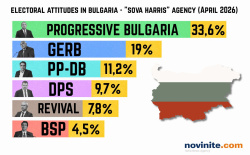
HOT: » Which party would you vote for (if you could) in the upcoming snap vote in Bulgaria on April 19?
 Send to Kindle
International transport companies in Bulgaria are coming under growing pressure as fuel prices continue to rise following the outbreak of war in the Middle East. Representatives of the sector warn that if the conflict drags on, some smaller firms could be pushed into bankruptcy, while consumers may soon feel the impact through higher prices for basic goods.
The recent surge in fuel costs has already begun to affect the country’s transport industry. Since the start of the month, companies have reported a decline in freight rates at the same time their operating expenses have climbed sharply. According to industry representatives, overall costs have risen by more than 35%, forcing some transport firms to refuse new transport contracts because of the uncertainty surrounding fuel prices and the ongoing military tensions in the Middle East.
Yordan Arabadzhiev, Executive Director of the Union of International Drivers, said the transport sector is among the first to experience the consequences of the price increases. Drivers and carriers, he noted, are directly exposed to the situation because they must refuel daily while operating on the road.
According to Arabadzhiev, the impact is particularly severe for companies operating international routes. Fuel prices across Europe have climbed significantly higher than those in Bulgaria, making it increasingly difficult for Bulgarian carriers to remain competitive while managing rising expenses abroad.
He explained that fuel prices in many European countries have already jumped by more than 35%, placing substantial pressure on transport businesses. The situation is further complicated by the way the industry operates financially. Transport companies typically receive payment for their services at least 30 days after completing deliveries, meaning many firms must cover the immediate increase in fuel expenses using their own funds.
As a result, some carriers are beginning to deplete their working capital while trying to keep operations running. The uncertainty surrounding future fuel costs has also forced several companies to cancel planned routes or postpone trips, as they are unable to calculate whether the transport contracts will remain profitable.
Industry representatives warn that if the current situation persists, the financial strain could become unbearable for smaller companies. Many of them already operate with limited reserves and depend heavily on steady cash flow, making them particularly vulnerable to sudden cost increases.
According to Arabadzhiev, a number of small transport firms may soon face serious difficulties servicing existing loans and financial obligations. If fuel prices continue to climb, this could lead to bankruptcies within the sector, especially among companies with fewer vehicles or limited financial resources.
The consequences, however, would not stop within the transport industry. Fuel accounts for roughly 30% to 35% of the cost structure of a typical road transport service, depending on the company’s specific business model. Because road transport is responsible for moving a large share of goods across the country, any increase in these costs quickly spreads throughout the supply chain.
For that reason, industry representatives expect the effects to reach consumers in the near future. According to the sector’s estimates, the rising cost of transport could lead to an increase in the prices of essential goods delivered by road.
Arabadzhiev said that by the end of the month, prices for basic goods transported by trucks could rise by between 3% and 7%. Such increases would affect every stage of the supply chain, ultimately reaching households and businesses that rely on these products.

Orthodox Easter Monday is the day following Easter Sunday and is observed across Bulgaria as part of the wider Easter celebration within the Orthodox Christian tradition

Industrial output in Bulgaria posted a modest monthly increase in February 2026, but continued to decline sharply on an annual basis, according to preliminary, seasonally adjusted data from the National Statistical Institute.

The president of the Confederation of Bulgarian Trade Unions, Plamen Dimitrov, has warned that inflation in Bulgaria is likely to exceed earlier projections, even if fuel prices begin to decline

The introduction of the euro in Bulgaria has so far produced only a limited and largely one-off effect on consumer prices, according to an analysis by the European Central Bank

Easter is the most important religious holiday in the Orthodox Christian calendar and is widely celebrated across Bulgaria. It marks the resurrection of Jesus Christ and follows the completion of Holy Week, which includes Good Friday and Holy Saturday

The Central Election Commission (CEC) in Bulgaria has confirmed that a total of 6,575,151 citizens are eligible to vote in the upcoming elections on April 19

Scroll through a busy news feed and you’ll spot a pattern - economic jitters, tech pivots, shifting consumer habits.

Dr. Boyko Takov: Analytical and empirical results from ongoing projects constitute a solid information base

Up to 90 percent of construction and renovation workers in Bulgaria are operating outside the legal framework, according to entrepreneur Lozan Lozanov, who raised concerns about the lack of regulation in construction and installation services

The Ministry of Finance has released a broad public dataset covering more than 7,000 public procurement contracts with a combined value exceeding 30 billion euros

Mobile slot gaming has exploded in popularity, and it’s easy to see why.

Caretaker Finance Minister Georgi Klisurski said he expects fuel prices at gas stations to ease in the coming period, pointing to a sharp decline in international oil markets

Aniventure Comic Con Returns to Bulgaria with Star Guest Christopher Judge!

Global Fuel Shock: Oil Jumps Over 40% Since Iran War Began