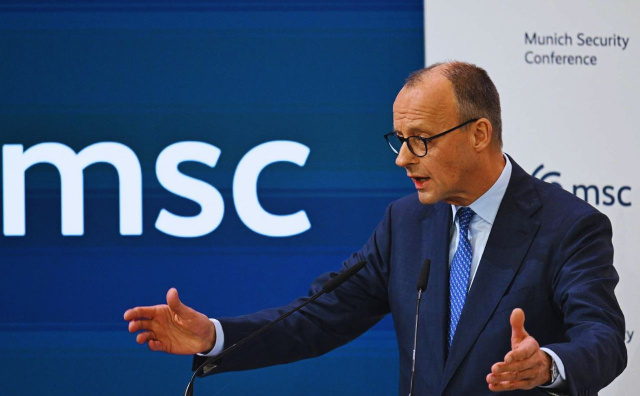
German Chancellor Friedrich Merz used his opening address at the Munich Security Conference to deliver one of the bleakest assessments yet of the global environment, declaring that the international order that shaped the postwar era has effectively collapsed. According to Merz, the rules-based system, imperfect even at its strongest, is no longer functioning, forcing countries like Germany to rethink their assumptions about security, alliances and self-defense.
He argued that the period following the fall of the Berlin Wall, when the United States stood as the dominant global power, has clearly ended. In its place has emerged a harsher era defined by rivalry among major powers, where even the strongest states face growing insecurity. Merz warned that power politics offers the illusion of simple solutions but in reality replaces predictability with speed, coercion and instability, eroding the legal and diplomatic frameworks that once restrained conflict.
Turning to transatlantic relations, Merz spoke of what he called an uncomfortable reality: the relationship between Europe and the United States can no longer be taken for granted. He said American leadership is being challenged and may already be fading, a shift that leaves Europe more exposed. While still committed to cooperation, Merz stressed that Europe must prepare for a future in which U.S. guarantees are less reliable and greater responsibility falls on European states themselves.
He openly acknowledged a widening political and ideological gap with Washington, particularly under President Donald Trump. Merz rejected U.S. culture wars, trade protectionism and withdrawals from multilateral frameworks, reaffirming Europe’s commitment to free trade, climate agreements and global institutions such as the World Health Organization. Applause from the audience followed his remark that American culture wars are not Europe’s battles.
Russia’s war against Ukraine featured prominently in Merz’s remarks. He said Europe has assumed a leading role in supporting Kyiv, imposing heavy economic and political costs on Moscow. According to the German leader, the conflict will end only when Russia concludes that continuing the war brings no further advantage. He expressed skepticism about Moscow’s readiness for genuine negotiations, citing past attempts at unilateral outreach that yielded no results and were followed by intensified attacks on civilian infrastructure.
Merz also emphasized that Europe’s freedom is now directly at risk. Despite the European Union’s economy being vastly larger than Russia’s, he said Europe has failed to convert its economic strength into comparable military, political and technological power. The challenge, he argued, is not a lack of resources but a lack of resolve, calling on Europeans to fundamentally change their mindset and fully mobilize their potential.
In a sign of how far Berlin’s thinking has shifted, Merz confirmed discussions with French President Emmanuel Macron about the possibility of a European nuclear deterrent. The talks reflect growing anxiety over whether the U.S. nuclear umbrella would reliably protect Europe in a major crisis. While Germany remains anchored in NATO, Merz made clear that Europe must be ready to stand more firmly on its own if needed.
He also issued a warning about China, arguing that Europe’s search for greater autonomy does not mean alignment with Beijing. Merz accused China of exploiting economic dependencies, including through controls on critical raw materials, and cautioned that its military power could soon rival that of the United States.
On broader security priorities, Merz said competitiveness and security are inseparable, urging stronger protection of critical infrastructure, more resilient supply chains, reduced dependence on strategic materials and technologies, and better safeguards for democratic institutions. He reiterated his goal of building Germany’s armed forces into the strongest conventional military in Europe and called for enhanced intelligence cooperation across the continent.
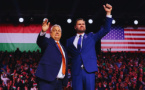
During a question-and-answer session, Merz again stressed that dialogue with Russia is only meaningful if it is backed by pressure. He recalled a European leader’s solo visit to Moscow that achieved nothing, followed by intensified Russian attacks, an apparent reference to Hungarian Prime Minister Viktor Orbán. For Merz, negotiations must serve the goal of ending the war, not legitimizing aggression.
Concluding his remarks, Merz framed the current moment as a test for Europe. Freedom, he said, is no longer guaranteed by default and must now be actively defended. That will require difficult choices, rapid change and shared sacrifice. Europe, he insisted, is not powerless, but it must act decisively if it wants to shape the new global order rather than be shaped by it.