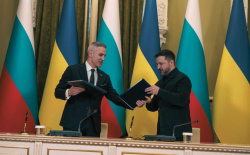
Easter Monday in Bulgaria: Tradition and Family Visits
Orthodox Easter Monday is the day following Easter Sunday and is observed across Bulgaria as part of the wider Easter celebration within the Orthodox Christian tradition
HOT: » Which party would you vote for (if you could) in the upcoming snap vote in Bulgaria on April 19?
 Send to Kindle
Bulgaria’s Foreign Ministry has reacted sharply to fresh statements from Skopje, voicing what it described as deep frustration over North Macedonia’s continued lack of openness and what Sofia sees as a deliberately unconstructive public narrative. According to the Bulgarian side, vague claims about behind-the-scenes EU initiatives only deepen mistrust rather than ease tensions.
In an official statement, the Ministry said it was once again hearing talk from Skopje about an alleged initiative by “larger and more influential EU member states” to arrange a meeting between the foreign ministers of the two countries. Sofia rejected these claims as imprecise and misleading, stressing that this was not the first time such assertions had been publicly floated without clarity or substance.
At the center of the controversy is Foreign Minister Timco Mucunski. In a televised interview on Sitel TV, he claimed that in December there had been serious efforts by several major EU countries, together with EU leadership, to broker a meeting between him and his Bulgarian counterpart, Georg Georgiev. According to Mucunski, Bulgaria declined. He went on to say that a new attempt, allegedly initiated from Brussels, was now underway and insisted that Skopje remained ready at any moment to “exchange arguments” once Sofia agreed.
Mucunski also voiced persistent concern that even if constitutional amendments are adopted to include the Bulgarian community, North Macedonia could once again face obstacles tied to identity, history and language. He accused Bulgaria of failing to implement rulings of the European Court of Human Rights and argued that real decisions require trust and dialogue rooted in European values. His message was that Skopje’s readiness for talks would not change, regardless of political developments or election outcomes in Sofia.
The minister further pointed to the country’s commitment to preparing an action plan on minority and community rights, which he described as a strong document developed by leading experts and positively received by many EU member states. He suggested that Bulgaria’s reaction to the plan was influenced by its domestic political situation, saying Sofia had adopted an “incorrect attitude” toward the document. Mucunski emphasized that the plan was not aimed specifically at the Bulgarian minority, but at expanding minority rights overall in line with high European standards, and warned that political exploitation of the issue would only complicate matters further.
Sofia’s response was swift and pointed. The Bulgarian Foreign Ministry reminded Skopje that the 2022 European Consensus was unanimously adopted by all EU member states, including North Macedonia itself. In that context, Bulgaria underlined that formal dialogue on accession remains between the candidate country and the European Union, and that progress depends entirely on Skopje fulfilling the commitments it has already accepted.
The Ministry insisted it has consistently shown readiness for open dialogue on all other bilateral matters. However, it accused Mucunski of avoiding such engagement in practice, not just rhetorically. As an example, Sofia cited his refusal to accept an invitation to visit Bulgaria on November 25, 2025, for an event honoring St. Kliment Ohridski, described as a key historical figure shared by both nations.
Addressing Mucunski’s criticism of Bulgaria’s stance on the minority rights action plan, the Foreign Ministry added another layer of concern. It noted that the draft was rejected by representatives of the Bulgarian community in North Macedonia themselves, who deemed it unacceptable due to the absence of core guarantees for human rights protection. Sofia stressed that it expects the legitimate demands of Bulgarians in North Macedonia to be taken seriously, rather than sidelined behind procedural documents and public messaging.
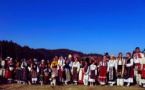
Orthodox Easter Monday is the day following Easter Sunday and is observed across Bulgaria as part of the wider Easter celebration within the Orthodox Christian tradition

Industrial output in Bulgaria posted a modest monthly increase in February 2026, but continued to decline sharply on an annual basis, according to preliminary, seasonally adjusted data from the National Statistical Institute.
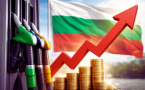
The president of the Confederation of Bulgarian Trade Unions, Plamen Dimitrov, has warned that inflation in Bulgaria is likely to exceed earlier projections, even if fuel prices begin to decline

The introduction of the euro in Bulgaria has so far produced only a limited and largely one-off effect on consumer prices, according to an analysis by the European Central Bank

Easter is the most important religious holiday in the Orthodox Christian calendar and is widely celebrated across Bulgaria. It marks the resurrection of Jesus Christ and follows the completion of Holy Week, which includes Good Friday and Holy Saturday

Holy Saturday, known in Bulgaria as Lazarus Saturday’s continuation of the Easter cycle, is a quiet but deeply symbolic day in the Orthodox Christian calendar
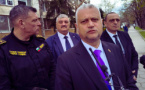
A mayor in northwestern Bulgaria is under scrutiny after allegedly distributing social benefits alongside a political party’s election materials
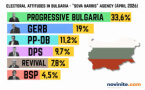
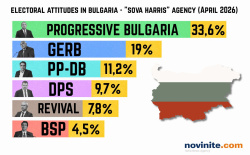
A new survey by the “Sova Harris” agency indicates that six political formations would enter the next Bulgarian National Assembly, based on data collected between April 2 and 6 among 800 respondents through standardized face-to-face interviews
Bulgaria is bracing for an increase in disinformation activity in the run-up to the parliamentary elections on April 19, with authorities warning of coordinated attempts to influence voters and destabilize public trust

The Prosecutorial College of the Supreme Judicial Council has declined to remove Borislav Sarafov from his position as Acting Prosecutor General, despite calls from the Justice Ministry to act following a recent Constitutional Court ruling

The government has decided to withdraw all three Bulgarian nominations for the position of European Prosecutor, effectively restarting the procedure after identifying serious flaws in the initial selection process
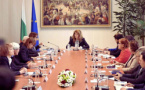
President Iliana Yotova convened a meeting of institutions responsible for the conduct of the early parliamentary elections on April 19, with a focus on assessing preparedness and ensuring that every vote is properly safeguarded

Aniventure Comic Con Returns to Bulgaria with Star Guest Christopher Judge!
Global Fuel Shock: Oil Jumps Over 40% Since Iran War Began