Putin Declares Easter Ceasefire in Ukraine War
The Kremlin has announced that Russian President Vladimir Putin has ordered an “Easter ceasefire” in the war in Ukraine, declaring a temporary halt in hostilities lasting around 36 hours
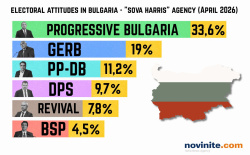
HOT: » Which party would you vote for (if you could) in the upcoming snap vote in Bulgaria on April 19?
 Send to Kindle
The United Kingdom is moving ahead with plans to develop a new long-range ballistic missile system for Ukraine, intended to strengthen Kyiv’s ability to strike deep behind Russian lines. According to British authorities, the initiative, known as Project Nightfall, is aimed at rapidly delivering ground-launched missiles with a range exceeding 500 kilometres as part of continued military support for Ukraine.
Under the Nightfall programme, the UK has opened a competitive process for domestic defence companies to design and build a ballistic missile capable of carrying a 200-kilogram warhead. The missile is intended to be mobile and vehicle-launched, allowing crews to deploy, fire and withdraw within minutes. If launched from Ukrainian territory, its range would be sufficient to reach targets as far away as Moscow.
London has earmarked £9 million for the initial design and development phase, offering contracts to produce the first three missiles for test launches. This amount is roughly equivalent to about €10.5 million, or approximately BGN 20.5 million. The goal is to move quickly from concept to testing, with an emphasis on survivability and speed in high-threat battlefield conditions.
The project has been confirmed by UK Defence Secretary John Healey, who has linked the initiative directly to the scale and intensity of Russian missile attacks on Ukraine. Healey recently visited Ukraine during a period of heavy Russian strikes, including the launch of an Oreshnik ballistic missile near the Polish border. He described hearing air raid sirens during his journey and said the experience reinforced the need to provide Ukraine with advanced, long-range weapons.
According to specifications released by the UK Ministry of Defence, the Nightfall system must be able to carry at least two missiles on a single launcher, reach a firing position and launch the full payload within 15 minutes, and allow the crew to leave the area within five minutes after firing. The missiles are designed to be launched in rapid succession, reducing the risk of counterstrikes while enabling attacks on high-value targets.
Production targets have also been outlined. Once development is complete, output is expected to reach at least 10 missiles per month, with the possibility of scaling up further. The maximum unit cost has been set at around $1.07 million per missile, which is roughly €1 million, or close to BGN 2 million.
Further details indicate that three industry teams could be awarded development contracts worth about $12 million each to deliver missiles for test firing within a year. This sum corresponds to approximately €11 million, or around BGN 21.5 million per contract. Proposals are to be submitted by early February, with contracts expected to be awarded in March 2026.
The concept of supplying Ukraine with Nightfall missiles has been under discussion since at least September 2025, when UK officials indicated that operational-tactical ballistic missiles could be provided once development was completed. At that stage, the Ministry of Defence estimated that identifying viable technical solutions would take between nine and twelve months, followed by the preparation of at least five fully operational prototypes for testing.
British officials have framed the project as part of a broader strategy to bolster European security by ensuring Ukraine has the means to continue resisting Russian attacks. As UK Defence Procurement Minister Luke Pollard put it, a secure Europe depends on a strong Ukraine, and the new missile system is intended to give Moscow additional reasons to think twice as the war continues.
The Kremlin has announced that Russian President Vladimir Putin has ordered an “Easter ceasefire” in the war in Ukraine, declaring a temporary halt in hostilities lasting around 36 hours
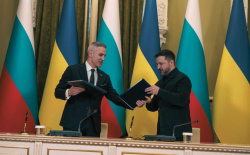
Acting Defense Minister Atanas Zapryanov has stated that Bulgaria is not taking on any military obligations under the ten-year security cooperation agreement with Ukraine
A political dispute in Bulgaria has recently centered on the bilateral security cooperation agreement with Ukraine, after criticism emerged over its signing without prior approval from the National Assembly
Acting Education Minister Sergey Ignatov said that his recent visit to Kyiv came at a critical moment, stressing that it could not be delayed. According to him, the signing of a protocol with his Ukrainian counterpart was decisive for the future of the Bu

Direct passenger rail services between Bulgaria and Ukraine, operating via Romania, are set to begin in June after the three countries reached an agreement on the key parameters of the route during a working meeting in Ruse.
Marin Raykov, Acting Deputy Foreign Minister, described the agreement between Bulgaria and Ukraine as a political document rather than a binding international arrangement, noting that it was adopted by the Council of Ministers in 2024.
The Kremlin has announced that Russian President Vladimir Putin has ordered an “Easter ceasefire” in the war in Ukraine, declaring a temporary halt in hostilities lasting around 36 hours
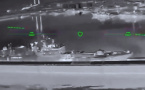
Ukrainian unmanned aerial vehicles targeted Russian military assets in the Black Sea port city of Novorossiysk during a night-time operation between April 5 and 6
Keith Kellogg, who previously served as US President Donald Trump’s Special Envoy for Ukraine, has raised the possibility of reshaping existing security structures, including moving beyond NATO
US President Donald Trump has stated that the United States should not have become involved in the war in Ukraine, arguing that the conflict is geographically distant and does not directly concern American interests

Four years after the liberation of Bucha, the town remains a central reference point for understanding the nature of the war in Ukraine and the limits of current diplomatic efforts.
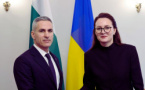
Acting Prime Minister Andrey Gyurov, during an official visit to Kyiv, reaffirmed Bulgaria’s continued support for Ukraine, stressing backing for its sovereignty, independence, and territorial integrity, according to the government press service.

Aniventure Comic Con Returns to Bulgaria with Star Guest Christopher Judge!

Global Fuel Shock: Oil Jumps Over 40% Since Iran War Began