The Power of Knowledge Lies in Its Use
Dr. Boyko Takov: Analytical and empirical results from ongoing projects constitute a solid information base
Business | April 9, 2026, Thursday // 18:21
HOT: » Which party would you vote for (if you could) in the upcoming snap vote in Bulgaria on April 19?
 Send to Kindle
 Pixabay
The laws in Bulgaria that regulate wiretapping and surveillance are of poor quality and cannot guarantee that the interference in the privacy of citizens meets the criteria of a democratic society.
This finding is made by the European Court of Human Rights (ECHR) in its decision not only on the legislation in our country but also on the practices for the use of Special Intelligence Device(s) (SID), Lex.bg reported.
The decision is full of examples of scandals and abuses of SIDs from the last 10 years. And after reviewing the SID Act and the Electronic Communications Act, the Strasbourg court came to the devastating conclusion for our country - that “surveillance in Bulgaria, applied in practice, does not yet meet the minimum safeguards against arbitrariness and abuse".
The case before the ECHR was filed by two lawyers - Mihail Ekimdzhiev (together with the Association for European Integration and Human Rights) and Alexander Kashumov (Access to Information Program). This is the second time that Ekimdzhiev has turned to the court in Strasbourg for the abuses of wiretapping and surveillance in our country. In 2007, on his complaint, the ECHR found serious problems with the storage of data collected by the SIDs, as well as the lack of a mechanism to establish whether he had been illegally wiretapped or monitored. It was because of this first decision, after long vicissitudes, that the SID Control Bureau was established.
Now Ekimdzhiev and Kashumov have asked the court to review the entire process - from its regulations, through requests for the use of SIDs, court permits to the inspection of the SID Control Bureau, and the possibility of seeking compensation in cases of illegal wiretapping.
Here is what today's conclusion of the Strasbourg court states:
"Although significantly improved after being examined by the Court at the request of the Association for European Integration and Human Rights and Ekimdzhiev, the laws governing secret surveillance in Bulgaria, implemented in practice, still do not meet the minimum safeguards against arbitrariness and abuse, required under Article 8 of the Convention in the following respects:
(a) the internal rules governing the storage and destruction of SID materials are not made available to the public;
b) the term “objects” in Art. 12, para. 1 of the 1997 Act is not defined in a way that ensures that it cannot serve as a basis for the indiscriminate use of SID. (Here, the Strasbourg court recalls the case of convicted former Sofia City Court President Vladimira Yaneva, who allowed the use of SIDs against the Interior Ministry's information system. Yaneva was not convicted because of this, but because of the statutory duration of SID permits. According to the EHCR the example is indicative that the Bulgarian courts interpret the concept of “object of SID” too broadly.);
c) the excessive duration of the initial authorization for surveillance for reasons of national security - 2 years, significantly weakens the judicial control to which such surveillance is subject;
(d) the procedure for authorizing the use of SIDs, as is the case in practice, is unable to ensure that monitoring is used only when "necessary in a democratic society";
(e) there are a number of gaps in the legal provisions governing the storage, access, verification, use, communication, and destruction of surveillance data;
(f) the supervisory system as it is currently organized does not meet the requirements for sufficient independence, competence, and powers;
(g) the conditions for informing citizens that SID has been used against them are too narrow
h) the special means of protection - the claim under Art. 2, para. 1, item 7 of the Law on the Liability of the State and Municipalities for Damages, in practice cannot be applied in all possible scenarios, does not guarantee verification of the justification of each case of use of SID, is not open to legal entities and is limited with regard to disposal.
These shortcomings in the legal regime seem to have had a real impact on the functioning of the covert surveillance system in Bulgaria.
Recurrent secret surveillance scandals suggest abuses that appear to be at least partly due to inadequate legal safeguards."
/OFFNews

Dr. Boyko Takov: Analytical and empirical results from ongoing projects constitute a solid information base

The European Public Prosecutor’s Office (EPPO) has carried out a series of coordinated investigative actions across several countries, including Bulgaria and Romania, as part of a probe into suspected large-scale fraud involving EU funds

Holiday weather conditions are expected to remain mixed across Bulgaria, with alternating periods of sunshine and rain showers, according to the forecast
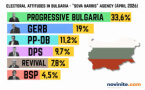
A new survey by the “Sova Harris” agency indicates that six political formations would enter the next Bulgarian National Assembly, based on data collected between April 2 and 6 among 800 respondents through standardized face-to-face interviews

Up to 90 percent of construction and renovation workers in Bulgaria are operating outside the legal framework, according to entrepreneur Lozan Lozanov, who raised concerns about the lack of regulation in construction and installation services

The Ministry of Finance has released a broad public dataset covering more than 7,000 public procurement contracts with a combined value exceeding 30 billion euros
A new survey by the “Sova Harris” agency indicates that six political formations would enter the next Bulgarian National Assembly, based on data collected between April 2 and 6 among 800 respondents through standardized face-to-face interviews

Bulgaria is bracing for an increase in disinformation activity in the run-up to the parliamentary elections on April 19, with authorities warning of coordinated attempts to influence voters and destabilize public trust

The Prosecutorial College of the Supreme Judicial Council has declined to remove Borislav Sarafov from his position as Acting Prosecutor General, despite calls from the Justice Ministry to act following a recent Constitutional Court ruling

The government has decided to withdraw all three Bulgarian nominations for the position of European Prosecutor, effectively restarting the procedure after identifying serious flaws in the initial selection process

President Iliana Yotova convened a meeting of institutions responsible for the conduct of the early parliamentary elections on April 19, with a focus on assessing preparedness and ensuring that every vote is properly safeguarded

Bulgaria’s caretaker Foreign Minister Nadezhda Neynsky said the announcement of a two-week ceasefire between the United States and Iran brought a sense of relief after weeks of escalating tensions in the Middle East

Aniventure Comic Con Returns to Bulgaria with Star Guest Christopher Judge!

Global Fuel Shock: Oil Jumps Over 40% Since Iran War Began