The Power of Knowledge Lies in Its Use
Dr. Boyko Takov: Analytical and empirical results from ongoing projects constitute a solid information base
Business | April 9, 2026, Thursday // 18:21
HOT: » Which party would you vote for (if you could) in the upcoming snap vote in Bulgaria on April 19?
 Send to Kindle
 pixabay.com
The EU Regulations clarifying the rules applicable to property regimes for international married couples or registered partnerships apply as of today.
The regulations establish clear rules in cases of divorce or death and bring an end to parallel and possibly conflicting proceedings in various Member States, for instance on property or bank accounts. In short, it will bring more legal clarity for international couples.
First Vice-President Timmermans said: "The entry into application of these regulations is good news for the growing number of international couples in Europe. This is about giving certainty to thousands of European couples about what happens to their property if they divorce or one of them dies. I am confident that these regulations will help many European couples manage such difficult times.”
Vera Jourová, EU Justice Commissioner said: “These new rules will make it easier and cheaper to divide joint assets and provide some relief to people in difficult circumstances. More than 16 million international couples will benefit from clear procedures in case of divorce or death of a partner. They will be able to save around €350 million each year in legal costs. I encourage the remaining Member States to join the enhanced cooperation for the sake of all international couples across the EU.”
As it was not possible to reach unanimity among all Member States, the rules will apply in 18 Member States: Austria, Belgium, Bulgaria, Croatia, Cyprus, Czechia, Finland, France, Germany, Greece, Italy, Luxembourg, Malta, the Netherlands, Portugal, Slovenia, Spain and Sweden.
The new regulations will:
The 18 Member States that joined the enhanced cooperation make up 70% of the EU population and represent the majority of international couples who live in the European Union. Those Member States adopted the Regulations in June 2016 under enhanced cooperation. The remaining Member States can join both Regulations any time.
The non-participating Member States will continue applying their national law (including their rules on private international law) to cross-border situations relating to matrimonial property regimes and the property consequences of registered partnerships.
Background
Enhanced cooperation allows a group of at least nine Member States to adopt measures if all 28 Member States fail to reach agreement. Other EU countries keep the right to join the enhanced cooperation when they want (Article 331 TFEU).
On 16 March 2011, the Commission adopted two proposals for regulations dealing with the property regimes of international couples: one for married couples and the other for registered partnerships. These were intended to complement the framework of EU instruments for judicial cooperation in the area of family law. The proposals had to be adopted by unanimity in the Council. In December 2015, the Council concluded that it was not possible to reach unanimity among the 28 Member States.
17 Member States requested the Commission for enhanced cooperation between them in the area of the property regimes of international couples, including both marriages and registered partnerships. Cyprus joined the enhanced cooperation at a later stage. In March 2016, the Commission tabled again the two proposals taking on board the political agreement reached in Council. On 24 June 2016 the Council adopted both Regulations.
Dr. Boyko Takov: Analytical and empirical results from ongoing projects constitute a solid information base
The European Public Prosecutor’s Office (EPPO) has carried out a series of coordinated investigative actions across several countries, including Bulgaria and Romania, as part of a probe into suspected large-scale fraud involving EU funds

Holiday weather conditions are expected to remain mixed across Bulgaria, with alternating periods of sunshine and rain showers, according to the forecast
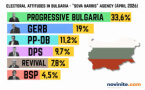
A new survey by the “Sova Harris” agency indicates that six political formations would enter the next Bulgarian National Assembly, based on data collected between April 2 and 6 among 800 respondents through standardized face-to-face interviews

Up to 90 percent of construction and renovation workers in Bulgaria are operating outside the legal framework, according to entrepreneur Lozan Lozanov, who raised concerns about the lack of regulation in construction and installation services

The Ministry of Finance has released a broad public dataset covering more than 7,000 public procurement contracts with a combined value exceeding 30 billion euros
The European Public Prosecutor’s Office (EPPO) has carried out a series of coordinated investigative actions across several countries, including Bulgaria and Romania, as part of a probe into suspected large-scale fraud involving EU funds
The caretaker government has approved a decision endorsing the Partnership Agreement between the European Union and its Member States and the Mercosur bloc

US Vice President JD Vance launched a sharp attack on the European Union during a visit to Budapest, accusing Brussels of interfering in Hungary’s election just days before a closely contested vote that could reshape the country’s political landscape
Fuel prices in Germany have recently reached new highs, with diesel briefly exceeding 2.40 euros per litre during the Easter holiday period before easing slightly afterward
A recently revised German military service framework has triggered public debate after it emerged that it places new travel-related obligations on men aged between 17 and 45

Spain has officially launched its system of digital identity, which came into effect on April 2 and grants the electronic version of the national identity card the same legal validity as the physical document

Aniventure Comic Con Returns to Bulgaria with Star Guest Christopher Judge!
Global Fuel Shock: Oil Jumps Over 40% Since Iran War Began