Bulgarians Spend 10-Year Average Wage For New Home
The residents of Denmark, Germany and Portugal can afford to buy a new home for 2.1 – 3 years with an average gross income, according to a recent Deloitte survey.
HOT: » Which party would you vote for (if you could) in the upcoming snap vote in Bulgaria on April 19?
 Send to Kindle
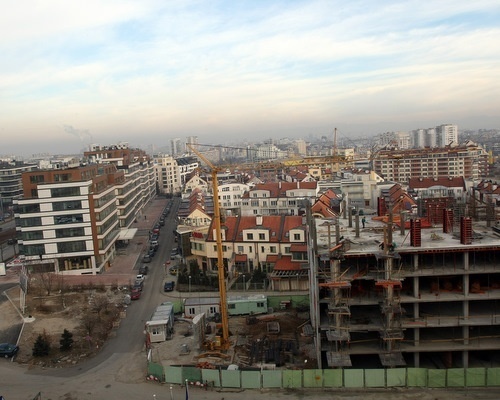 Very few, if any, new residential projects are expected to break ground during the second half of 2009. Photo by BGNES
Average asking sales prices of residential property in the Bulgarian capital Sofia fell by 14% at the start of the second half of the year on an annual basis, data of the realtor Colliers International Bulgaria shows.
On a half-year basis the figure is approxiomately 10%, demonstrating that the largest fall happened in the first half of 2009.
Behind these figures, however, are significant differences between the various areas.
Average asking sales prices fell almost 20% on average in the prime neighborhoods in the first half of the year. Doctor's Garden has experienced the largest decrease (almost 33%) going below to EUR 1,500/m2. This is partly driven by unrealistic/opportunistic offers being removed from the market.
The average asking sales prices in the Ivan Vazov neighborhood decreased with 17%, while in Lozenets the decrease was 12%. Iztok, which was the only area showing an increase in the prices by the end of 2008, has now seen a reversal of fortune with an average decrease in average asking sales prices of 11%.
The emerging neighborhoods proved more resilient with average falls of 6%. The largest change was seen in Bukston (dipping just below the EUR 1,000/m2 mark), followed by Gotze Delchev with a 10% decrease. The areas of Vitosha (EUR 1,036/m2 on average) and Manastirski Livadi (EUR 1,078/ m2 on average) showed almost no decrease, compared with the previous half year period.
The experts expect the restrictive financial situation to continue to influence the residential supply in the second half of 2009 as developers delay the completion of their projects. Very few, if any, new projects are expected to break ground during this period.
Sales prices and rental prices are expected to fall slightly in short term period, followed by a consolidation towards the end of the year and the beginning of 2010.
Given the fundamental health of the residential market, the fact that demand is driven by genuine economics and demographics and the moderately positive outlook for the Bulgarian economy, the residential market is expected to start recovering in the first half of 2010, Colliers experts forecast.

The residents of Denmark, Germany and Portugal can afford to buy a new home for 2.1 – 3 years with an average gross income, according to a recent Deloitte survey.
The index of residential property prices calculated each quarter by Bulgaria's National Statistical Institute has gone by 0.

The apartment prices in the Bulgarian capital Sofia have declined below EUR 1 000 per square meter for the first time in five years, according to a report by Arco Real Estate, a consultancy.

Despite a temporary livening up of the residential property market in Bulgaria over the past year, the prospects remain gloomy, concluded participants in a real estate conference in Sofia.

The average residential property prices in the Bulgarian capital Sofia have dropped by 9.

The prices for residential properties in Bulgaria have increased by an average of 200% in the last decade, according to analysis of real estate agency "Bulgarian Properties", based on data from the National Statistics Institute (NSI) and the Registry Agen

Housing prices in Bulgaria have surged by 157% between 2015 and the end of 2025

The Bulgarian real estate market is showing signs of cooling in early 2026, with experts reporting a slowdown in transactions and a shift toward more balanced conditions between buyers and sellers

In 2026 the Bulgarian residential market is shaped less by size and more by adaptability.
Bulgaria’s entry into the Eurozone marks a defining moment for the country’s real estate sector.

The housing market in Bulgaria is undergoing notable shifts, with buyers increasingly prioritizing location and accessibility over sheer size.

Property values in Sofia have surged by approximately €500 per square metre over the past year, according to data from one of Bulgaria’s largest real estate agencies. Across the country’s main cities, housing costs climbed by 20% in the final quarter of 2

Aniventure Comic Con Returns to Bulgaria with Star Guest Christopher Judge!

Global Fuel Shock: Oil Jumps Over 40% Since Iran War Began