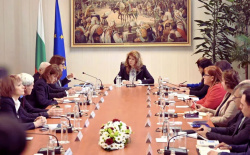
Asen Vassilev, leader of “We Continue the Change,” stated in an interview with Nova TV that the upcoming elections present a rare opportunity for a political shift, arguing that voters could significantly reduce the parliamentary influence of Boyko Borissov and Delyan Peevski. He claimed that for the first time since 2009, there is a realistic chance for these two political figures to collectively fall below 80 seats in parliament.
Vassilev said that any political force willing to join what he described as this “battle” would be welcome. He framed the election campaign as a decisive confrontation with what he called a long-standing governing model, insisting that change cannot be achieved through rhetoric, social media statements, or general political messaging, but through concrete institutional decisions.
He referred to the mass protests of the previous year, stating that citizens had demanded early elections and a political break from Borissov and Peevski. According to him, this goal requires systematic action in key state institutions, including the election of a new Supreme Judicial Council and accountability for those entering it. He raised questions about whether incoming officials would support removing individuals linked to influence networks in the judiciary.
Vassilev also directed expectations toward President Rumen Radev and the political space associated with “Progressive Bulgaria,” asking for clear positions on specific governance measures. These included potential changes related to security arrangements, health system procurement rules, transparency in healthcare spending, and reforms in judicial appointments and mandates of state bodies.
He argued that removing entrenched influence requires legislative action such as replacing key judicial institutions, reducing salaries of officials with expired mandates, and restructuring oversight mechanisms. In his view, these steps are necessary to dismantle what he described as a system of informal control over public institutions.
The “We Continue the Change” leader compared the current political struggle to the Bulgarian-Serbian War of 1885, suggesting that in moments of national crisis, leadership sometimes falls to those outside the highest ranks. He used this analogy to stress what he described as the seriousness and historical weight of the upcoming elections.
Vassilev also commented on individuals linked to Radev’s political lists, claiming that some candidates previously had affiliations with GERB, DPS, TISP, and BSP. He questioned how effective anti-corruption efforts could be if individuals who had previously participated in the existing political system were now part of a force claiming to oppose it.
He further referred to a recent exchange with former defense minister and current candidate Dimitar Stoyanov, describing a brief confrontation in Simeonovgrad in which he asked repeatedly whether support would be given to remove NSO security protection from Borissov and Peevski. According to Vassilev, agreement was eventually given, which he presented as an example of practical steps needed to dismantle entrenched influence.
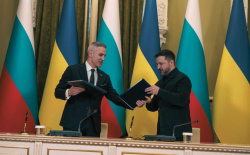
When asked about the 10-year security agreement signed with Ukraine, Vassilev said it originated during the time of Dimitar Glavchev. He expressed the view that the agreement is beneficial for Bulgaria but suggested the timing of its signing was not optimal. He also noted that, in his interpretation, the agreement does not create direct financial obligations, contrasting it with other international contracts.
He added that the agreement contributes to political positioning on geopolitical orientation, framing it as a dividing line between pro-European and pro-Russian stances. Vassilev reiterated support for a strong European direction for Bulgaria and argued that peace would be achieved through Russian withdrawal from Ukraine. He criticized President Radev’s position, claiming it reflects a different approach to the war and its resolution.