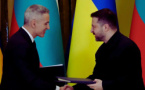
Turkey's prime minister Recep Tayyip Erdogan (L), the President of the European Commission, Jose Manuel Barosso (C) and President of Georgia Mikhail Saakashvili (R) arrive for a meeting for Intergovernmental agreement on Nabucco. Photo by EPA/BGNES
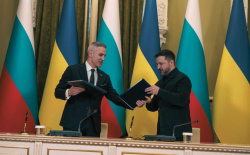
Bulgaria PM Sergey Stanishev signed an agreement Monday along with four other countries to construct the Nabucco natural gas pipeline.
Turkey, Romania, Hungary and Austria also signed the agreement at a meeting in Ankara.
Turkey's Prime Minister Recep Tayyip Erdogan said deal was an "historic moment", cited by the BBC.
Once completed, the Nabucco pipeline line will bring up to 31 billion cubic metres of gas a year from the Caspian and the Middle East across Turkey and into Europe. The preliminary completion date is 2014.
It will give an alternative energy supply to Russia, which already meets 30% of Europe's gas needs.
But much still remains to be agreed on, not least where the gas will come from.
The five countries, Turkey, Romania, Bulgaria, Hungary and Austria, have been working on the Nabucco project with the European Commission for seven years now.
Following the signing, Erdogan said that the legal framework for the construction of the pipeline would now be agreed within six months.
"The more steps we take [on realising the project], the more the interest of supplier countries will grow," he said.
Azerbaijan will be the main source of Nabucco's gas when the pipeline is opened, due by 2014.
However, two weeks ago, the country agreed to sell some of its gas to Russia, a move many understood as a warning to the Nabucco partners to sort out their differences or look elsewhere.
Iran, Iraq, Kazakhstan, Turkmenistan and Egypt are all considered potential suppliers to Nabucco in the longer term.
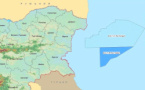
Meanwhile, Russia is planning two of its own new gas pipelines to Europe, the Nord Stream, which will run direct from Russia to Germany under the Baltic Sea, and the South Stream, which will run from southern Russia under the Black Sea to Bulgaria.