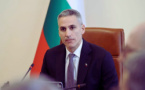
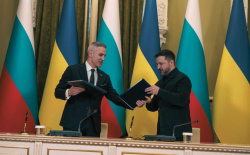
Gyurov (left), Zhelyazkov (right)
The transition of power in Bulgaria was marked by a formal ceremony in the Granite Hall of the Council of Ministers, where former Prime Minister Rosen Zhelyazkov handed over authority to Acting Prime Minister Andrey Gyurov. Zhelyazkov described the moment as one of responsibility both accepted and transferred, emphasizing that in a political career, two dates stand out: the day a leader assumes office, filled with commitments and expectations, and the day they leave, a moment of reckoning where lessons are learned. He noted that history rarely remembers titles or positions, but always records the decisions made when necessary.
During his farewell, Zhelyazkov thanked his colleagues for facing difficult choices and not taking the easy path. Addressing Gyurov, he expressed confidence in the new prime minister’s ability to distinguish successes from failures, build upon achievements, and correct errors. He framed the handover as a continuation of governance, describing it as a “torch” that can illuminate the future while leaving the past behind.
Gyurov, in turn, highlighted the role of democratic instincts in society, noting that citizens exercise their voice to change power without causing destruction. He pledged that the caretaker government would not operate on revanchist principles but would act according to established rules. For him, the priority is to regain public trust through transparency in decision-making and accountability for every euro spent.
“The goal is national unity, not through consensus of opinion, but through adherence to rules,” Gyurov said. He stressed the importance of fair elections as the foundation for achieving this objective. Citizens, he noted, have demonstrated their concerns through protests, seeking security for their families, opportunities for their children, and a fair environment for business. The caretaker government’s mission is to address these expectations without delay.
The ceremony followed the swearing-in of the Gyurov Cabinet in the National Assembly. From the parliamentary rostrum, Gyurov reaffirmed that the government will manage the country until a regular cabinet is formed, “without hysteria, grounded in reason and reality.” He emphasized that the caretaker administration aims for honest governance, starting with the assurance of a transparent and fair electoral process.
President Iliana Yotova, present at the transition, underscored that she would closely monitor the implementation of Gyurov’s seven-point agenda, ensuring the caretaker government adheres to its commitments.
Zhelyazkov reiterated his advice to the new leadership, reminding them of the dual responsibility inherent in political office: to act decisively when taking charge and to leave a legacy of effective decisions upon departure. Gyurov echoed these sentiments, describing the moment as a “returning” to democratic values and a reaffirmation of societal preservation through civic participation.
He stressed that the government’s work would not focus on political retribution but on achieving key objectives. Restoring public confidence requires transparency in all expenditures and strict accountability. Equally important is securing national unity through fair and predictable rules, anchored by a credible electoral process.
Gyurov concluded by highlighting immediate priorities: ensuring security for citizens, supporting families, and maintaining fair competition in the economy. With the caretaker cabinet officially in place, Bulgaria enters a period of interim governance centered on rule-based management, transparency, and preparation for the upcoming elections.