Easter Monday in Bulgaria: Tradition and Family Visits
Orthodox Easter Monday is the day following Easter Sunday and is observed across Bulgaria as part of the wider Easter celebration within the Orthodox Christian tradition
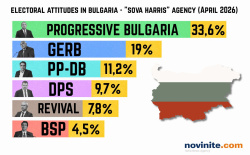
HOT: » Which party would you vote for (if you could) in the upcoming snap vote in Bulgaria on April 19?
 Send to Kindle
A recent survey has revealed that while the majority of Bulgarians support their country's NATO membership, a significant 30 percent would vote to leave the alliance, placing Bulgaria at the top among all 32 member countries in terms of withdrawal inclination.
The poll, conducted ahead of the upcoming NATO summit in Washington, showed that 59 percent of Bulgarians prefer their country to remain in NATO, which is the lowest support percentage among NATO nations. Additionally, 11 percent of respondents were undecided on the matter. Excluding those undecided, the percentages shift to 66 percent in favor of staying in NATO versus 34 percent for leaving.
These findings were part of a broader survey distributed in Brussels, reflecting opinions across member states. NATO Secretary General Jens Stoltenberg referenced the survey results during a press conference, noting that 70 percent of citizens across NATO countries would vote to stay in the alliance, with only 14 percent preferring to leave. He emphasized widespread support for continued aid to Ukraine among NATO members.
Regarding Bulgaria specifically, the survey indicated that 61 percent of Bulgarians believe NATO membership enhances their country's security. This sentiment places Bulgaria ahead of several other NATO nations, including Belgium, France, Italy, Slovenia, and the USA, in terms of confidence in NATO's security guarantees. Conversely, 29 percent of Bulgarians expressed concerns that NATO membership might not ensure their country's safety, a figure exceeded only by Italians.
The survey also highlighted that 69 percent of Bulgarians consider NATO membership important for their country's future security, a sentiment shared equally with Italians. However, opinions varied among other NATO nations, with lower percentages in countries such as France, Greece, North Macedonia, Montenegro, Slovakia, Slovenia, and the USA. Conversely, 13 percent of Bulgarians believe that NATO membership does not significantly impact their country's security, a sentiment more prevalent in Greece, North Macedonia, Montenegro, Slovakia, and Slovenia.
When asked about defense commitments, 42 percent of Bulgarians agreed that Bulgaria should defend another NATO country if it is attacked, placing Bulgaria among the countries with higher levels of support for collective defense within NATO. Meanwhile, 26 percent of Bulgarians disagreed with this statement.
Regarding media trust related to Ukraine's conflict coverage, only 28 percent of Bulgarians expressed trust in their country's media, with 66 percent indicating distrust. This places Bulgaria ahead of Greece and Hungary in media distrust but behind several other NATO nations.
NATO member states are expected to discuss substantial aid packages for Ukraine during the Washington summit, including military assistance and security training. Stoltenberg anticipates reaffirming NATO's commitment to provide minimum military aid to Ukraine annually, along with additional support such as air defense systems and ammunition.
Stoltenberg also commented on Hungarian Prime Minister Viktor Orbán's recent visit to Moscow, emphasizing that while Orbán represents Hungary and not NATO at such meetings, all NATO member states agree on Russia's role as the aggressor in the Ukraine conflict. He underscored NATO's commitment to Ukraine's territorial integrity and sovereignty.
Orthodox Easter Monday is the day following Easter Sunday and is observed across Bulgaria as part of the wider Easter celebration within the Orthodox Christian tradition

Industrial output in Bulgaria posted a modest monthly increase in February 2026, but continued to decline sharply on an annual basis, according to preliminary, seasonally adjusted data from the National Statistical Institute.
The president of the Confederation of Bulgarian Trade Unions, Plamen Dimitrov, has warned that inflation in Bulgaria is likely to exceed earlier projections, even if fuel prices begin to decline

The introduction of the euro in Bulgaria has so far produced only a limited and largely one-off effect on consumer prices, according to an analysis by the European Central Bank

Easter is the most important religious holiday in the Orthodox Christian calendar and is widely celebrated across Bulgaria. It marks the resurrection of Jesus Christ and follows the completion of Holy Week, which includes Good Friday and Holy Saturday

Holy Saturday, known in Bulgaria as Lazarus Saturday’s continuation of the Easter cycle, is a quiet but deeply symbolic day in the Orthodox Christian calendar
The personnel deficit in the Bulgarian Armed Forces stood at 20.5% in 2025, marking a slight improvement of 1.8 percentage points compared to the previous year, according to the Report on the State of Defence and the Armed Forces, approved by the caretake
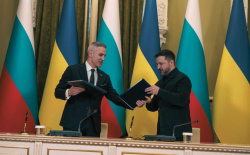
Acting Defense Minister Atanas Zapryanov has stated that Bulgaria is not taking on any military obligations under the ten-year security cooperation agreement with Ukraine
Acting defense Minister Atanas Zapryanov said that the concept of Bulgaria relying on its own defense outside a collective system would place an unsustainable burden on the country’s economy and public finances

Journalist Hristo Rimpopov told Bulgarian National Radio that there is no basis to assume Bulgaria could become a target of Iranian attacks, following confirmation by the Foreign Ministry that Tehran had sent a diplomatic note concerning the presence of U
Acting Foreign Minister Nadezhda Neynski has stated categorically that Bulgaria will not take part in any military coalition aimed at reopening the Strait of Hormuz, citing the country’s limited capabilities
The Council of Ministers has adopted the Report on the State of Defense and the Armed Forces of the Republic of Bulgaria for 2025, which was submitted to both the National Assembly and the public, outlining an overall assessment of military readiness and

Aniventure Comic Con Returns to Bulgaria with Star Guest Christopher Judge!
Global Fuel Shock: Oil Jumps Over 40% Since Iran War Began