Inflation in Turkey Rises to 23-year High of nearly 79% in June
- Tweet
 Send to Kindle
 @Pixabay
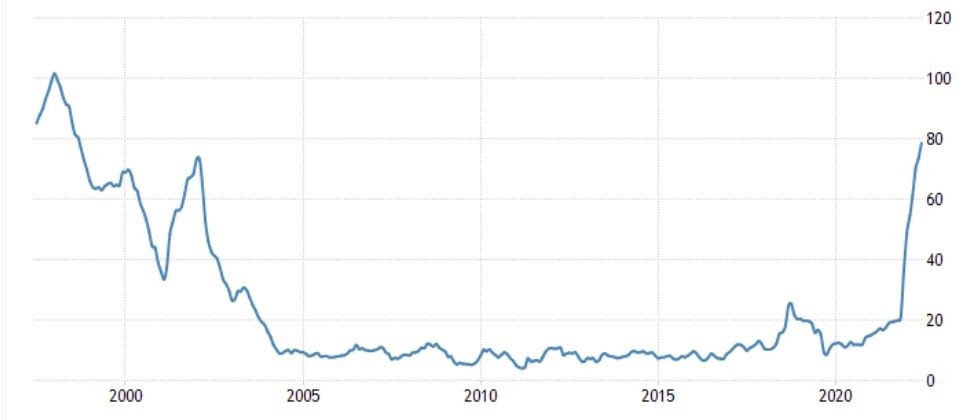
Turkish inflation rose year-on-year in June to a 23-year high of 78.62%, its acceleration for the 13th consecutive month boosted by the weakness of the local currency (the Turkish lira) and the negative effects of Russia's military invasion of Ukraine, which are expressed in a continued strong increase in the prices of raw materials.
Turkey's Consumer Price Index (CPI) rose in June by 4.95% compared to May, the country's official statistics show.
Compared to a year earlier, inflation in June accelerated to 78.62% from 73.5% in May.
This is the country's highest inflation since September 1998 and much higher than June 2021 (17.53%).
Graph of inflation in Turkey on an annual basis
The most drastic growth in June on an annual basis was in transport prices (a jump of as much as 123.37%) as a result of the sharp increase in energy prices against the background of the war in Ukraine, followed by that of food and soft drinks prices (by 93 .93%), on furniture and household equipment (increase by 81.14%) and on prices in hotels, cafes and restaurants (increase by 79.55%).
The weakest annual price increases in June were in communications (up 23.74%), clothing and footwear (up 26.99%), education (up 27.78%) and healthcare (up 39.34%).
Earlier in June, Turkey's central bank kept its key interest rate unchanged at 14% despite a sharp rise in prices in the country, with the bank again saying it expects inflation to start falling.
At the same time, producer prices (PPI) increased in June by 6.77% from the previous month and increased by as much as 138.11% from June 2021. This is a clear sign that consumer inflation in Turkey will continue to grow strongly in the coming months.
Follow Novinite.com on Twitter and Facebook
Write to us at editors@novinite.com
Информирайте се на Български - Novinite.bg
/BNR

Bulgaria’s Central Bank Tightens Rules on Housing Credit
The Bulgarian National Bank (BNB) has decided to increase the countercyclical capital buffer to 2.25%, in a move aimed at easing pressure on the rapidly growing housing credit market and strengthening the resilience of the banking system.

Bulgaria Publishes 7,000 Public Contracts Worth Over €30 Billion in Transparency Push
The Ministry of Finance has released a broad public dataset covering more than 7,000 public procurement contracts with a combined value exceeding 30 billion euros
Bulgaria Expects Fuel Price Drop as Oil Falls 20%, Says Finance Minister
Caretaker Finance Minister Georgi Klisurski said he expects fuel prices at gas stations to ease in the coming period, pointing to a sharp decline in international oil markets
Borrowing Surge: Bulgaria Raises Over €1 Billion in Early 2026 Debt Issuance
Bulgaria’s new government borrowing for 2026 has surpassed the 1 billion euro mark following the latest successful auction of state securities, according to data cited from the Bulgarian National Bank

Is Another Crisis Coming? Bulgaria’s Central Bank Chief Flags Inflation Spiral Risk
Bulgaria recorded only a modest and one-off increase in inflation following the adoption of the euro on January 1, with the effect estimated at between 0.3 and 0.4 percentage points

Bulgaria Records 1.5 Billion Euro Budget Deficit in March, Highest in 15 Years
Data released by the Ministry of Finance, covering budget execution for February 2026 and preliminary estimates for March 2026, indicate a marked deterioration in Bulgaria’s fiscal position