Bulgarians' Summer Travel Surge: Greece Tops Destination List
As travel restrictions eased following the COVID-19 pandemic, people from Bulgaria and beyond eagerly resumed their journeys
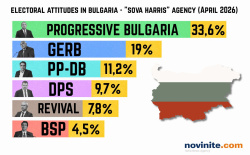
HOT: » Which party would you vote for (if you could) in the upcoming snap vote in Bulgaria on April 19?
 Send to Kindle
 Capital
After the first day of school, Sofia seems to be starting a new life - traffic and traffic jams are returning, parking lots are becoming less and less, and nerves are becoming more and more. To avoid congestion, most Sofia residents travel by subway. However, if we compare the number of people who traveled by metro this year between September 15 and 26, and those who traveled in the same period in the past two years, we will notice that there is a tendency for them to be less and less.
For example, for this period in 2019 (before the pandemic) the total number of passengers was 3.05 million, in 2020 - 2.47 million, and in 2021 their total number fell by 79 thousand and includes the third metro diameter. This is clear from data provided to "Capital" by "Metropolitan".
Fewer and fewer people use public transport
The logical explanation behind the downward trend in subway passengers is the coronavirus pandemic - although there have been no closures during these periods, people are avoiding public transport because of the high risks. Which leads to more car traffic and traffic jams around schools. The interpretation of the data for such a short period is still conditional, as there are always factors that can distort the statistics.
In general, public transport is not recommended during a pandemic, and the lack of more frequent flights or trains and therefore the required distance is another prerequisite for people not to use public transport. This is confirmed by a study of the Moovit travel app from 2020, conducted in 104 cities and 28 countries around the world. According to him, nearly a third of people in different cities have stopped using public transport because of the coronavirus. The main reason is the changed habits of people, lockdowns and remote work.
For example, in Thessaloniki, 34.3% of people say they did not use public transport in 2020, and 45% said they board public flights less often, according to an article in the World Economic Forum.
How long do we wait for the subway?
Last week it became clear that the Sofia Municipality has increased the intervals of movement to a total of 20% of the land lines of public transport, arguing that they do not pick up passengers. The decision was made on the basis of a new ticket system, which uses cameras to count how many passengers board vehicles. This naturally caused dissatisfaction among people who found out about the changes in a difficult way - while waiting at the bus stop, or from social networks. Moreover, the public transport in Sofia is not very convenient and connected and is not associated as an alternative to the car.
However, the metro train schedules have not changed since 2019, according to "Metropolitan". As of September 15, the "winter schedules" of the trains are already in force, and on weekdays at rush hour we wait 3 minutes for a train for the stations of the first metro diameter. Otherwise, you usually wait 6 or even 9 minutes for a train in the remaining hours.
Most waiting occurs at stations of the second metro diameter
The trains at the stations of the second metro diameter ("Lozenets" - "Obelya") are waiting the most, it is clear from a reference of "Metropolitan". At rush hour a train arrives every 6 minutes, and during the rest of the time on average every 9 minutes according to the published timetables on the website of the Center for Urban Mobility.
During the holidays, all stations wait 6 minutes for a train at rush hour and 9-12 minutes in other time zones, according to the Sofia metro. It is also impressive that the trains at the stations of the new, third, metro diameter come relatively quickly at peak hours - they are every 4 and a half minutes.
/Capital

As travel restrictions eased following the COVID-19 pandemic, people from Bulgaria and beyond eagerly resumed their journeys

The World Health Organization (WHO) has updated its list of pathogens that could potentially spark a new pandemic

In 2023, Sofia Airport saw a significant recovery in passenger numbers, surpassing pre-pandemic levels observed in 2019
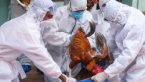
The World Health Organization (WHO) has issued a stark warning regarding the spread of bird flu (H5N1) to various species, including humans, expressing deep concern over its impact and potential consequences

Bansko, Bulgaria's premier mountain resort, experienced a surge in winter tourism, with more than 190,000 visitors flocking to its slopes during the season

The European Food Safety Agency (EFSA) issued a stark warning regarding the looming threat of a large-scale bird flu pandemic, underscoring the potential consequences if the virus were to transition to humans and establish human-to-human transmission

Health authorities in Bulgaria report a total of 101 confirmed measles cases across the country, according to data from the Ministry of Health
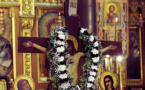
Good Friday, known in Bulgaria as Razpeti petak, is one of the most solemn and deeply observed days in the Orthodox Christian calendar

The Bulgarian scientific research vessel “Sts. Cyril and Methodius” (NIC 421) has returned to Varna, docking at the Marine Station and marking the official end of the country’s 34th Antarctic expedition
Holiday weather conditions are expected to remain mixed across Bulgaria, with alternating periods of sunshine and rain showers, according to the forecast
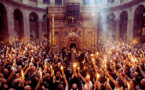
The Bulgarian Orthodox Church has decided that no official delegation will travel to Jerusalem this year to receive the Holy Fire, citing the ongoing tensions in the Middle East

Plovdiv will host the International Street Arts Festival 6Fest from April 20 to 26, 2026, turning the city into an open-air stage featuring performers from 11 countries across three continents

Aniventure Comic Con Returns to Bulgaria with Star Guest Christopher Judge!
Global Fuel Shock: Oil Jumps Over 40% Since Iran War Began