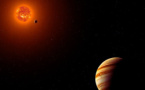
Astronomers have found a cool, Earth-sized planet that's relatively close to our Solar System, reported BBC.
The properties of this newly discovered planet - called Ross 128 b - make it a prime target in the search for life elsewhere in the cosmos.
At just 11 light-years away, it's the second closest exoplanet of its kind to Earth.
But the closest one, known as Proxima b, looks to be less hospitable for life.
Found in 2016, it orbits the star Proxima Centauri, which is known to be a rather active "red dwarf" star. This means that powerful eruptions of charged particles periodically batter Proxima b with harmful radiation.
The new planet, Ross 128 b, orbits a star that's not dissimilar to Proxima Centauri (it's also a red dwarf), but is significantly less active.
The new world was discovered by a team using the High Accuracy Radial velocity Planet Searcher (Harps) instrument at the La Silla Observatory in Chile. The work will be published in the journal Astronomy & Astrophysics.
Dr Astudillo-Defru said the find was the result of more than a decade of "intensive monitoring" using the Harps instrument.
Ross 128 b orbits 20 times closer to its star than the Earth orbits the Sun. But because its parent star is much smaller and dimmer than our yellow sun, it receives only a little more solar radiation than Earth.
Consequently, it is expected to have a surface temperature close to that on our own planet.
In the search for habitable worlds beyond our Solar System, astronomers generally look for low-mass, rocky and temperate planets like our own.
But these are comparatively difficult to detect; most of the 3,500 known exoplanets are so-called Hot Jupiters - huge gas giants orbiting very close to their parent stars that don't have suitable conditions for life.
Of the smaller contingent of Earth-sized planets, the vast majority orbit red dwarf stars - the most common type in the Milky Way. Because this category of star is dim, it's easier for astronomers to detect low-mass planets when they pass in front (as viewed from Earth), blocking out a portion of the light.


 pixabay.com