Is Russian Oil Flowing to Bulgaria in 2026?
Bulgaria's only oil refinery, Lukoil Neftochim Burgas, processed Russian crude for most of its post-Soviet history. Since March 2024, that has been banned by law
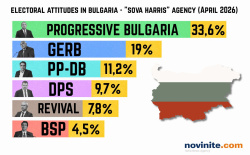
HOT: » Which party would you vote for (if you could) in the upcoming snap vote in Bulgaria on April 19?
 Send to Kindle
 The Belene nuclear power plant has been de facto frozen since the fall of 2009 when the previously selected strategic investor, the German company RWE, pulled out. Photo by Sofia Photo Agency
Bulgaria will rely on two back-up plans as Russia's Atomstroyexport is seeking EUR 1 B in compensation over the cancellation of nuclear power plant Belene, the energy minister has said.
"We hired the best lawyers, who have repeatedly won court cases against some of the biggest Russian companies. Their opinion is that we have every reason to believe we will win the case," Delyan Dobrev said in the morning broadcast of bTV channel on Wednesday.
In his words Rosatom's claim against Bulgaria's National Electricity Co. of EUR 1 B is "totally unrealistic".
Minister Dobrev explained that the Bulgarian side has offered Moscow a few options on how to settle the scores without resorting to the arbitration court.
"Even if we have to pay something, the sum will be much smaller. But from now on we will pay nothing," the minister stressed.
Minister Dobrev slammed the procedure for the construction of Belene nuclear power plant as "state treason", flawed from the beginning in 2006 by "corrupt politicians with vested interests".
In the middle of July Russia's state nuclear company Atomstroyexport took Bulgaria's NEK to an arbitration court for EUR 58 M over delayed payments for its work on two nuclear reactors.
The next day the Bulgarian company said it is ready to strike back with a EUR 61 M counter claim against Atomstroyexport over delayed payments for purchases of old equipment for the plant, worth about EUR 300 M.
Three months later, on September 11, Rosatom Corp., Russia's state-run nuclear company, increased a claim against Bulgaria's National Electricity Co. from EUR 58 M to EUR 1 B.
Atomstroyexport, a unit of Rosatom, said it increased its claim filed with the International Court of Arbitration in Paris in 2011 to cover construction work and production costs of the two canceled nuclear reactors.
After it was first started in the 1980s, the construction of Bulgaria's second nuclear power plant at Belene on the Danube was stopped in the early 1990s over lack of money and environmental protests.
After selecting the Russian company Atomstroyexport, a subsidiary of Rosatom, to build a two 1000-MW reactors at Belene and signing a deal for the construction, allegedly for the price of EUR 3.997 B, with the Russians during Putin's visit to Sofia in January 2008, in September 2008, former Prime Minister Stanishev gave a formal restart of the building of Belene. At the end of 2008, German energy giant RWE was selected as a strategic foreign investor for the plant.
The Belene NPP has been de facto frozen since the fall of 2009 when the previously selected strategic investor, the German company RWE, which was supposed to provide EUR 2 B in exchange for a 49% stake, pulled out.
Shortly afterwards BNP Paribas SA, France's largest bank by market value, who was hired by the previous Socialist government to help fund the construction of Belene, ditched the project in February 2010.
RWE's departure from Bulgaria's new Belene nuclear plant put extra pressure on the new center-right government to find new shareholders while it redefines the scope of investment it needs.
NEK initially held a 51% stake in the scheme and Borisov's government planned to cut its shares in the project to 20-30%, which will still allow the country to keep its blocking quota.
Atomstroyexport was contracted in 2005 to build the plant for an initial 4 billion euros, but the costs later rose.
After failing to agree on its cost and find Western investors however in March 2012 Bulgaria decided to abandon plans to build its second nuclear power plant.

Bulgaria's only oil refinery, Lukoil Neftochim Burgas, processed Russian crude for most of its post-Soviet history. Since March 2024, that has been banned by law

Energy expert Martin Vladimirov from the Center for the Study of Democracy has warned that fuel prices in Bulgaria have not yet reached their peak, adding that the country is gradually converging with average EU levels.

Former Defense Minister Prof. Todor Tagarev has commented on Bulgaria’s military aviation situation, noting concerns about the condition of the country’s current fighter fleet and the pace at which new aircraft are being integrated.

Healthcare costs in Bulgaria are rising at a significantly faster pace than overall inflation, with price growth in the sector in 2026 roughly twice the national average compared to 2025

Hungary’s Tisza party leader Péter Magyar has said the country cannot abandon Russian oil supplies at present, stressing the continued importance of deliveries via the Druzhba pipeline and expressing hope that flows will resume after recent disruptions.

Around half a million Bulgarians chose to spend Easter inside the country, while roughly 120,000 traveled abroad

Bulgargaz has submitted a proposal to the Energy and Water Regulatory Commission (EWRC) suggesting a natural gas price of €35.98 per megawatt hour (MWh) for May

Acting Energy Minister Traycho Traykov said Bulgaria should not tap into its 90-day fuel reserves to ease prices, stressing that they must remain a safeguard in case of an actual supply disruption
Bulgaria has secured a six-month extension of the Lukoil waiver, following a decision by the US Treasury Department’s Office of Foreign Assets Control (OFAC)

Energy expert Boyan Rashev has warned that Europe could be moving toward what he described as an “energy lockdown” scenario if fuel supply pressures continue to worsen

Fuel prices in Bulgaria have continued to edge upward, with diesel and gasoline both registering increases in the days following the Easter holiday
The president of the Confederation of Bulgarian Trade Unions, Plamen Dimitrov, has warned that inflation in Bulgaria is likely to exceed earlier projections, even if fuel prices begin to decline

Aniventure Comic Con Returns to Bulgaria with Star Guest Christopher Judge!
Global Fuel Shock: Oil Jumps Over 40% Since Iran War Began