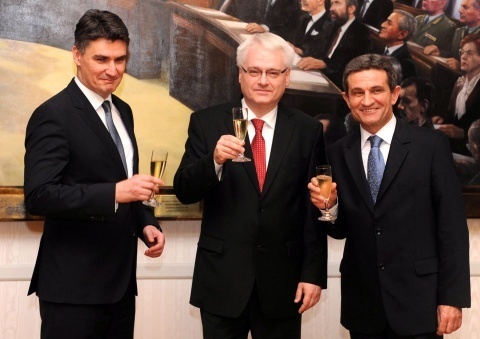
Croatian President Ivo Josipovic (C), Prime Minister Zoran Milanovic (L) and the Parliament speaker Boris Sprem (R) make a toast upon hearing unofficial results of the referendum, at the Croatian Parliament in Zagreb, 22 January 2012. EPA/BGNES
Croatia and Cyprus are about to increase their value added tax as the beginning of next month in a bid to cope with the crisis and rake in more revenues in the budget.
The planned value added tax hike in Croatia will push it from 23 to 25% and make it one of the countries in Europe with the highest VAT rate, alongside Denmark, Sweden and Norway.
In Croatia, VAT was imposed on 1 January 1998 at the rate of 22%. It was increased by one per cent on 1 August 2009.
In Cyprus the value-added-tax will increase from 15% to 17% on March 1. Thus, the government hopes to reduce the projected budget deficit to 2.4% of gross domestic product (GDP) in 2012 from 6% last year.
The European Commission warned Cyprus that it faces the threat of financial penalties if it does not reduce the deficit to below 3% of GDP.
Hungary has the highest VAT rate in Europe at 27%. The lowest VAT rate in the European Union - 15% - is in force in Luxembourg.
After a series of U-turns Bulgaria's government decided at the end of May 2010 to scrap plans for an increase of the 20% value added tax in a bid to plug a budget gap that has thwarted the new EU member's efforts to join the euro in the near future.
The VAT increase has been a thorny issue in Bulgaria for months on end with the cabinet changing their mind numerous times and several versions tossed around, ranging from 22% to 24%.
The VAT hike was proposed as part of a package of new austerity measures, which also include the introduction of a luxury tax, floating minority stakes in state-owned companies and a possible bond issue.
Politicians, analysts and trade unions took a firm stand against the hike, citing a long line of negative repercussions – an increase in the inflation rate, an expansion of the grey sector, a slow-down in the economic growth, in short a boost for the impact of the crisis.
Representatives from all business sectors cautioned that the hike in the value-added tax in Bulgaria should be a last-ditch measure, introduced only together with an overhaul in government expenditure and structural reforms.