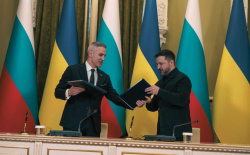
Foreign Investments in Bulgaria Rise 14% in 2025
Foreign direct investment in Bulgaria recorded steady growth in 2025, increasing by 14.2 percent compared with the previous year and reaching a total of 3.261 billion euros
HOT: » Which party would you vote for (if you could) in the upcoming snap vote in Bulgaria on April 19?
 Send to Kindle
 UniCredit Bulbank's chief economist Kristofor Pavlov. Photo by Capital
Investment interest towards Bulgaria is set to start growing slowly after the summer of 2012, according to the chief economist of UniCredit Bulbank Kristofor Pavlov.
The increased messages about the resolving of the euro zone crisis, and especially the reduced likelihood that Greece will abandon the euro are going to be an indication for the Bulgarian companies and households, Pavlov told the Euroclub at the Bulgarian Chamber of Commerce and Industry on Wednesday.
"First of all, however, the improvement of outside conditions will influence the Bulgarian economy through the channeling of expectations," he stated.
The chief economist of UniCredit Bulbank stressed that employment will be stabilized by the unfreezing of firms' investment projects in 2012 but that a more tangible improvement in the employment environment is to come after 2013.
"Households will start changing their attitude by putting off less their purchases of long-term goods. In accord with the increase of the consumer demand, the demand for credit will start growing relative to the unsatisfactory levels at present," Pavlov explained.
According to UniCredit Bulbank, Bulgaria's quarter-on-quarter growth rate will grow to 0.5%-0.7% in the last two quarters of 2012, up from the almost zero quarterly growth at the end of 2011. Its GDP growth forecast for Bulgaria in 2012, however, is 1.5%, which is lower than the 2% that the country achieved in 2011.
"The start of the year will test the Bulgarian economy. The worsening external environment will affected exports negatively," Pavlov said, stressing that the declining real estate prices will be one of the hurdles for the Bulgarian economy.
"We have ahead of us two or even three years in which Bulgaria's economic growth will be lower than its potential, with alternating periods of slowdowns and growth," he explained.

Foreign direct investment in Bulgaria recorded steady growth in 2025, increasing by 14.2 percent compared with the previous year and reaching a total of 3.261 billion euros

The Romanian government is moving to reshape the country’s economy by shifting the focus from consumption-driven growth to investment-led development, according to Finance Minister Alexandru Nazare.

2025 marked a historic year for investment gold, both globally and in Bulgaria, with record prices and growing investor interest. Over the past 12 months, gold surged nearly 60% year-on-year, setting more than 50 new price peaks, confirming its position a

The three leading telecommunications operators in Bulgaria inject more than 640 million BGN (≈327 million EUR) annually into the development of networks and services

Foreign direct investment in Bulgaria reached €2.53 billion by the end of September 2025, preliminary data from the Bulgarian National Bank indicate.

Bulgaria is experiencing stagnation in investment, with spending on productive capital reaching roughly 18% of GDP by 2024
Caretaker Finance Minister Georgi Klisurski said he expects fuel prices at gas stations to ease in the coming period, pointing to a sharp decline in international oil markets
Bulgaria’s new government borrowing for 2026 has surpassed the 1 billion euro mark following the latest successful auction of state securities, according to data cited from the Bulgarian National Bank

Bulgaria recorded only a modest and one-off increase in inflation following the adoption of the euro on January 1, with the effect estimated at between 0.3 and 0.4 percentage points
Data released by the Ministry of Finance, covering budget execution for February 2026 and preliminary estimates for March 2026, indicate a marked deterioration in Bulgaria’s fiscal position

In the 2026 edition of the Index of Economic Freedom, compiled by the Heritage Foundation, Bulgaria is placed 38th out of 176 countries, positioned between Costa Rica and Oman
Finance officials and the Bulgarian National Bank have issued a series of warnings about Bulgaria’s fiscal and economic outlook for 2026, highlighting rising pressure on public finances, slower growth, and higher inflation.

Aniventure Comic Con Returns to Bulgaria with Star Guest Christopher Judge!
Global Fuel Shock: Oil Jumps Over 40% Since Iran War Began