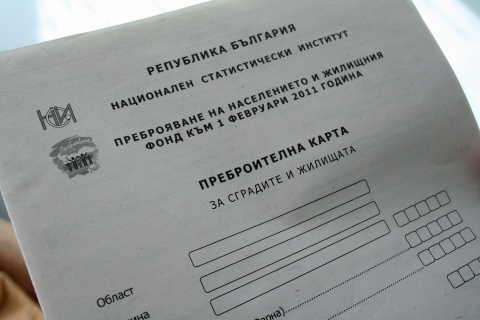
The 2011 Census in Bulgaria was conducted between February 1 and 28. File photo
Bulgaria's population has decreased by over half million people (581 750) since the 2001 Census, according to data from the National Statistics Institute, NSI.
NSI announced Tuesday the first official express results from the 2011 Census in Bulgaria. The Census was conducted between February 1 and 28 with an online Census until midnight on February 9.
Bulgarians in the country are now 7 351 234. Of them nearly 73% (5 357 633) live in cities and towns and 27% (1 993 602) live in villages.
The results were presented by NSI Director, Mariana Kotseva.
From 1992 until 2011, the population went down by 773 784 over the negative natural growth while 410 472 have emigrated. The largest population decrease has been registered in 2002 – by 46 118 people.
Between 2001 and 2011, the number of the residents of the capital Sofia grew by 185 532. Currently 1 359 520 people live in Sofia.
The Census further registered 2 826 740 households in the country or an average of 2.6 people per household; there were 3 898 688 residencies with an average of 1.9 people inhabiting them.
By February 1, 2011, women in Bulgaria were 3 770 897 or 51%, while men were 3 580 337 or 49% meaning there are 1 053 women for 1 000 men compared to 1 052 to 1 000 in 2001.
Children, ages 0 to 17, are 1 172 208 (16%); people ages 18 to 64 are 4 789 967 while those over 65 are 1 389 059.
According to the NSI report, there are changes in the age ratio with an increased demographic ageing and a decreased number of people under 18 – in 2001 the latter were 19.4% of the entire population while those between the ages of 18 and 64 were 63.9% in 2001 and are now 65.2%.
The largest increase is registered for those over 65 – from 16.8% in 2001 to 18.9% in 2011.