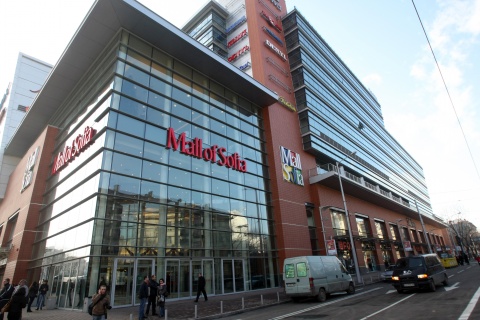
The malls in Sofia have affected strongly the stores on main commercial streets in the Bulgarian capital. Photo by BGNES
Rents on commercial streets in Sofia, which were affected by the opening of the malls in the recent years, will continue to drop, according to a report by UniCredit Bulbank on the development of the real estate in Bulgaria.
The analysis showed that at present the prices per square meter per month at the main commercial streets in Sofia vary between EUR 35-60. However, the tendency is for further reducing of the prices and for more difficult finding of tenants for the vacant premises.
As a result, during the season of winter sales, the clients are more likely to go shopping at the malls than the streets of Sofia, the analysts believe.
The delay in part of the projects for shopping centers, which was caused by the financial crisis, has affected positively the market. The completion of all projects would have flooded the market of such areas, the report states.
There was no activity in the market in 2009 in Sofia, but in 2010, the biggest shopping centers so far, The Mall and Serdika Center, opened doors.
In this way, the commercial space in the Bulgarian capital doubled and reached about 200,000 square meters. It will increase even more with the opening of Mega Mall, which is scheduled for 2011. It will add 25,000 square meters to the area of the malls.
The total size of commercial areas in Bulgaria in the end of 2010 was more than 500,000 square meters.
Despite the pressure from tenants, rents in the malls remain relatively stable, between EUR 7-35 per square meter per month, depending on the size of the store.
The reason for the stability, according to the report, is the fact that the average percentage of vacant premises at present is small to moderate. However, this could change in the future after the opening of new shopping centers.
The report of UniCredit Bulbank stated that the office space is constantly increasing, especially in Sofia. In 2010, the total area increased by more than 200,000 square meters. This led to a drop of their occupancy and of their prices.
In the logistics market in Sofia, the supply of new areas reacts faster to the drop in the demand. According to the UniCredit analysts, in 2010, new projects were started only by companies which needed them.
As a result, there is a lack of good industrial areas, but such are not built because of the sharp increase in the percentage of the vacant spaces, which was about 8,5% in 2010, comapred to 4% in 2006.