Bulgaria Sees Foreign Direct Investment Surge Nearly 50% to €1.4 Billion in May
Foreign direct investment (FDI) in Bulgaria reached €1.4 billion in May 2025, marking a notable increase of 46.9% compared to the same month in the previous year
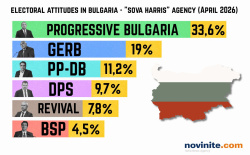
HOT: » Which party would you vote for (if you could) in the upcoming snap vote in Bulgaria on April 19?
 Send to Kindle
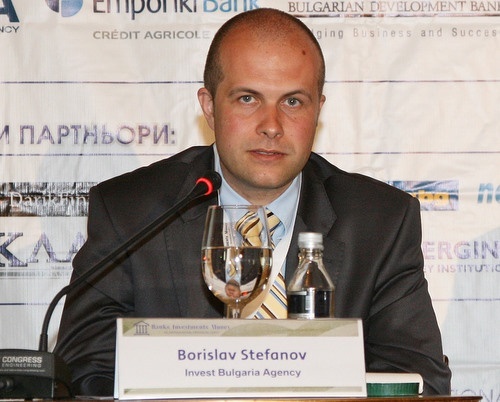 The new head of the InvestBulgaria Agency Borislav Stefanov was one of the keynote speakers at the "Banks Investment Money" forum in Sofia. Photo by M3 Communications Group, Inc.
Bulgaria is most likely to restore its pre-crisis level of foreign direct investments in 2013-2016, according to Borislav Stefanov, the recently appointed director of the InvestBulgaria Agency.
“Optimistic scenarios about the development of Eastern Europe show that Bulgaria can expect to regain its levels of FDI from the peak years 2007-2008 in 2013. According to the pessimistic forecasts, this will happen in 2016,” Stefanov declared as he was attending a meeting organized by AmCham, the American Chamber of Commerce in Bulgaria, entitled “Bulgaria’s Competitive Advantages in Attracting Foreign Investors.”
The InvestBulgaria Agency head based this prediction on a report of international auditing firm PricewaterhouseCoopers, which says that in 2003-2008 the volume of foreign direct investments in Eastern Europe increased five-fold – from USD 30 B to USD 150 B (even though most of these went to Russia.)
The economic crisis that kicked in at the end of 2008 resulted in a 50% reduction of these FDI levels.
“Bulgaria’s best year in terms of foreign investments was 2007 when it attracted a total of EUR 9 B, and 2008, when they amounted to EUR 6 B. Thus, if these forecasts about Eastern Europe come trues Bulgaria should restore its investment levels from 2007-2008 between 2013 and 2016,” Stefanov explained.
He has stressed the intention of the InvestBulgaria Agency, a government body handling inquiries by foreign investors, to facilitate investments in sectors with a high added value such as industry and IT services.
In his words, the Bulgarian Cabinet is expected to approve by July 7 the draft amendments of the Investment Encouragement Act proposed by his agency, which entail new incentives for foreign companies. The changes include expanding the list of industries eligible for state aid to include logistics and tourism based on Bulgaria’s cultural heritage.
Stefanov said that in the last few years three sectors – construction, finances, and commerce – attracted over 70% of all FDI in Bulgaria. He added that these sectors will continue to account for a sizable share of the country’s total foreign investments but that it will continue to decline at the expense of other branches of the economy, probably plummeting to 35%-40%. In the first half of 2010, the FDI in finances, construction and trade in Bulgaria declined six-fold year-on-year.
The InvestBulgaria Agency head did point out that in the last five years Bulgaria’s export of hi-tech products doubled, which he cited in support of his institution’s intention to focus on high added-value industries.
Stefanov also mentioned the preliminary data of the Bulgarian National Bank about foreign investments in Bulgaria in April amounting to EUR 36 M, up from EUR 29 M in the same month of 2009.
“Bulgaria is one of the economically stable countries in the region. We have lived through one of the most serious economic crisis in decades without resorting to bailout loans from the International Monetary Fund. Our economic stability is boosted by the low state debt, which is only 15% of the GDP, ranking Bulgaria third in the EU after Estonia and Luxembourg. In order to improve the macroeconomic climate, the Bulgarian businesses have to invest in hi-tech and high added value goods,” he declared.
The InvestBulgaria Agency director has insisted that the country has to take advantage of the fact that under EU regulations it is allowed to provide up to 50% of state aid to foreign investors for certain industries.
“The EU allows a certain level of state subsidies to investors depending on their development level. In most of the Western European states, this subsidy is 0%. In Central and Eastern Europe it ranges from 0% to 50%. For Bulgaria, it is the maximum allowed of 50%. Of course, the money comes from the state budget, not from the EU funds, which is probably Bulgaria does not provide 50% aid to every single project. But this could be decisive factor for attracting many investors,” Stefanov said.
In his words, the Agency will ask the government to introduce direct grants to foreign investors because currently the state only provides indirect subsidies for infrastructure and training of personnel.
“For example, the infrastructure subsidy kicks in when somebody is building a new factory in Bulgaria, and the state constructs a road to it. But this does not involve a transfer of money from the state to the company. What we would like to introduce is to reimburse the investors directly for some of their expenditures as soon as they carry certain parts of the investment project, i.e. the government could reimburse them with a certain amount of money when they complete 30% or 50% of their project,” explained Stefanov.
Novinite.com (Sofia News Agency) interview with the new head of the InvestBulgaria Agency Borislav Stefanov READ HERE

Foreign direct investment (FDI) in Bulgaria reached €1.4 billion in May 2025, marking a notable increase of 46.9% compared to the same month in the previous year

Foreign direct investment (FDI) in Bulgaria recorded a net positive flow of 1.24 billion euros for the first nine months of 2024

Prime Minister Nikolai Denkov heralds a momentous achievement in Bulgaria's economic landscape, revealing an astounding 50% surge in foreign investment during 2023

Foreign investments in Bulgaria have soared in the first ten months of 2023, reaching nearly EUR 3.4 billion—an impressive increase of over EUR 1.1 billion from the same period in 2022, marking a remarkable 53.6% year-on-year growth

Foreign direct investment in Bulgaria in the first three months of the year recorded an outflow of 27.

Mainly driven by the economic fallout from the coronavirus pandemic, global foreign direct investment (FDI) in 2020 slipped by 42% year-on-year to $859 billion, according to the UN's trade and development body.
Dr. Boyko Takov: Analytical and empirical results from ongoing projects constitute a solid information base

Up to 90 percent of construction and renovation workers in Bulgaria are operating outside the legal framework, according to entrepreneur Lozan Lozanov, who raised concerns about the lack of regulation in construction and installation services
The Ministry of Finance has released a broad public dataset covering more than 7,000 public procurement contracts with a combined value exceeding 30 billion euros

Mobile slot gaming has exploded in popularity, and it’s easy to see why.
Caretaker Finance Minister Georgi Klisurski said he expects fuel prices at gas stations to ease in the coming period, pointing to a sharp decline in international oil markets

Boris Azarenko is an entrepreneur whose professional background lies in banking and finance and who later founded major property development businesses.

Aniventure Comic Con Returns to Bulgaria with Star Guest Christopher Judge!
Global Fuel Shock: Oil Jumps Over 40% Since Iran War Began