Full text of the EC Report Putting Bulgaria under Excessive Deficit Procedure*
(News article on the EC Setting Bulgaria under the excessive deficit procedure READ HERE)
REPORT FROM THE COMMISSION
Bulgaria Report prepared in accordance with Article 126(3) of the Treaty
1.THE APPLICATION OF THE STABILITY AND GROWTH PACT IN THE CURRENT CRISIS SITUATION
Many EU countries are presently facing general government deficits above the 3% of GDP reference value set in the Treaty. The often strong deterioration in the deficit as well as the debt positions must be seen in the context of the unprecedented global financial crisis and economic downturn. Several factors are at play.
First, the economic downturn brings about declining tax revenue and rising social benefit expenditure (e.g. unemployment benefits).
Second, recognising that budgetary policies have an important role to play in the current extraordinary economic situation, the Commission called for a fiscal stimulus in its November 2008 European Economic Recovery Plan (EERP), endorsed by the European Council in December.
The Plan explicated that the stimulus should be differentiated across Member States to reflect their different positions in terms of public finance sustainability and competitiveness and should be reversed when economic conditions improve.
Finally, several countries have taken measures to stabilise the financial sector, some of which impact on the debt position or constitute a risk of higher deficits and debt in the future, although some of the costs of the government support could be recouped in the future.
The Stability and Growth Pact requires the Commission to prepare a report such as the present one whenever an actual or planned deficit of a Member State exceeds the 3% of GDP reference value. This report, which represents the first step in the “excessive deficit procedure” (EDP), analyses the reasons for the breach of the reference value with due regard to the economic background and all other relevant factors.
The amendments to the Stability and Growth Pact in 2005 aimed specifically at ensuring that in particular the economic and budgetary background was fully taken into account in all steps in the EDP.
This means for instance that, if an “excessive deficit” is deemed to exist, adequate attention needs to be paid to the economic background and outlook when making recommendations on the pace of the correction.
In this way, the Stability and Growth Pact provides the framework supporting government policies for a prompt return to sound budgetary positions taking account of the economic situation.
2.LEGAL BACKGROUND
This report, which assesses recent and current budgetary developments in Bulgaria and reviews the short- and medium-term prospects in the light of overall economic conditions and policy action taken by the government, is prepared according to Article 126(3) of the Treaty on the Functioning of the European Union (TFEU).
Article 126 of the TFEU lays down an excessive deficit procedure (EDP). This procedure is further specified in Council Regulation (EC) No 1467/97 “on speeding up and clarifying the implementation of the excessive deficit procedure”1, which is part of the Stability and Growth Pact.
According to Article 126(2) of the Treaty, the Commission has to monitor compliance with budgetary discipline on the basis of two criteria, namely: (a) whether the ratio of the planned or actual government deficit to gross domestic product (GDP) exceeds the reference value of 3% (unless either the ratio has declined substantially and continuously and reached a level that comes close to the reference value; or, alternatively, the excess over the reference value is only exceptional and temporary and the ratio remains close to the reference value); and (b) whether the ratio of government debt to GDP exceeds the reference value of 60% (unless the ratio is sufficiently diminishing and approaching the reference value at a satisfactory pace).
Article 126(3) stipulates that if a Member State does not fulfil the requirements under one or both of these criteria, the Commission has to prepare a report. This report also has to “take into account whether the government deficit exceeds government investment expenditure and take into account all other relevant factors, including the medium-term economic and budgetary position of the Member State”.
Over the past decade, Bulgaria has been conducting sound fiscal policy maintaining general government surpluses. Therefore, the Commission has not initiated an EDP procedure with regard to the country.
3. DEFICIT CRITERION
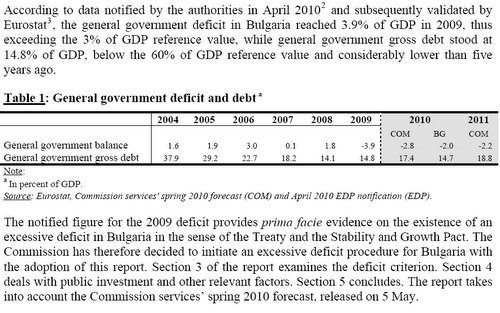
In 2009, the general government deficit reached 3.9% of the GDP.
Well in excess of 3% of GDP, it is not close to the Treaty reference value.
The excess over the 3% of GDP reference value is exceptional. In particular it results from a severe economic downturn in the sense of the Treaty and the Stability and Growth Pact. The global economic and financial crisis hit hard the economy of Bulgaria and the negative annual GDP volume growth reached 5% in 2009.
The deterioration stemmed from sharp contractions in both external demand and foreign investment inflows. Reflecting the fall in investment and private consumption, domestic demand declined abruptly, driving down indirect tax revenue, which account for more than 40% of government revenue in Bulgaria.
The scale of the economic contraction was unexpected, i.e. according to the 2008 update of the convergence programme the government expected real GDP to grow by 4.7% in 2009. As a result of the downturn the budgetary balance swung from a surplus of 1.8% of GDP at the end of 2008 to a deficit of 3.9% of GDP as the implemented measures to curb expenditures and improve tax compliance were not enough to offset the significant revenue shortfall.
Given the need to maintain macroeconomic stability under the currency board arrangement the government did not adopt stimulus measures. Therefore, the deterioration was mainly driven by a shortfall of revenue as a result of the unexpectedly sharp downturn and a change in GDP composition.
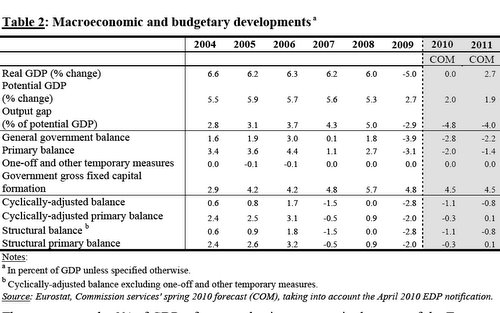
The excess over the 3% of GDP reference value is temporary in the sense of the Treaty and the Stability and Growth Pact. The Commission services’ spring 2010 forecast indicates that the general government deficit will fall below the reference value already in 2010 following the end of the worst part of the current severe economic downturn and as a result of the fiscal consolidation measures undertaken by the government4. The current assessment is that real GDP will continue to contract in the first half of 2010 and the economic recovery will start towards the end of the year, accelerating in 2011.
Based on this macroeconomic assessment and also taking into account recent developments in general government receipts and expenditures, on unchanged policies assumption, the deficit is expected to be on a declining path and to remain below the 3% of GDP reference value both in 2010 (at 2¾% of GDP) and in 2011 (at 2¼% of GDP). The government intends to close the budgetary gap in 2011 and to achieve a balanced general government budget.
In sum, the deficit is not close to the 3% of GDP reference value, although the excess over it is exceptional and temporary in the sense of the Treaty and the Stability and Growth Pact. This analysis suggests that the deficit criterion in the Treaty is not fulfilled.
4.RELEVANT FACTORS
Article 126(3) of the Treaty provides that the Commission report “shall also take into account whether the government deficit exceeds government investment expenditure and take into account other relevant factors including the medium-term economic and budgetary position of the Member State”.
These factors are further clarified in Article 2(3) of Council Regulation (EC) No 1467/97, which also specifies that “any other factors which, in the opinion of the Member State concerned, are relevant in order to comprehensively assess in qualitative terms the excess over the reference value and which the Member State has put forward to the Commission and to the Council” need to be given due consideration.
In view of the above provisions, the following four subsections consider in turn (1) the medium-term economic position; (2) the medium-term budgetary position (including public investment); (3) other factors put forward by the Member State; and (4) other factors considered relevant by the Commission.
4.1.Medium-term economic position
Cyclical conditions and potential growth. Before the onset of the global economic and financial downturn Bulgaria had witnessed strong real GDP growth underpinned by fast credit expansion and large foreign investment inflows. As the global economic crisis unfolded, economic activity was severely impacted, resulting in a 5% contraction of real GDP in 2009. The output gap turned sharply negative in 2009 and would rise further in 2010.
It would also remain in negative territory over 2011-2012. According to the Commission services' spring forecast the economic contraction is expected to end in the second half of 2010 and the economy should start growing again on annual basis in 2011.
Initially, the main driver of the economic recovery is expected to be net exports. However, the shift towards a less tax rich growth composition may pose further challenges for the government revenues in the near term and the envisaged considerable fiscal consolidation in 2010.
Recent structural reforms. Upon taking office in July the new government undertook several expenditure reducing measures, namely additional cuts in primary expenditure beyond the 90% budget rule, abstaining from initially planned wage increase in the public sector, compressing subsidies, capital spending, maintenance and operation expenditure, streamlining and downsizing public administration as well as freezing pensions.
Higher efficiency of public services delivery was achieved by closing down two ministries and three state agencies in 2009 and shifting their functions to other line ministries. In the revenue administrations (tax and customs) was undertaken a large scale reform.
A new integrated approach to EU funds management has been put in practice with the establishment of a new administrative structure within the Council of Ministers, which provides for a better coordination of the implementation of Operational Programs. The spending control has been further enhanced. The government foresees further implementation of structural reforms in 2010 in the area of health care, education and pensions in order to improve the public administration efficiency and the sustainability of public finances.
4.2.Medium-term budgetary position
Structural deficit and fiscal consolidation in good times. During the past economic good times Bulgaria has achieved consistently high fiscal surpluses and accumulated large fiscal reserves, reflecting buoyant economic growth and considerable revenue windfalls.
On the expenditure side, there was a decline in the government expenditure-to-GDP ratio as well as a certain expenditure restructuring towards more growth enhancing items, such as capital expenditures. The medium-term budgetary strategy of the government is to set the general government budget deficit on a declining path, bringing it down below the reference value at 2% of GDP already in 2010, and to achieve a balanced budget from 2011 onwards.
The structural balance is expected to improve from a deficit of 2.9% of GDP in 2009 to deficits of 1.1% of GDP and 0.8% of GDP in 2010 and 2011, respectively. Therefore, the fiscal stance is projected to be restrictive both in 2010 and in 2011. The achievement of these targets would require considerable and frontloaded fiscal consolidation already in 2010 and depends on the expected improvement of the macroeconomic environment.
Public investment. Government investment (as a share of GDP) was larger than the budget deficit and amounted to 4¾% of GDP in 2009, down from 5¾% of GDP in 2008 but still higher than the 2007 level. It was consistently maintained above 4% of GDP in the period 2006-2009.
According to the January 2010 update of the convergence programme public investment is set to remain unchanged at 5.1% of GDP until 2012. Therefore, it is planned to be well above the general government deficit in the entire period 2009-2012.
The Commission services’ forecast projects that the general government deficit ratio would continue to be below the public investment ratio also in 2010-2011 when the budgetary gap is expected to be brought down below the reference level of 3% of GDP as a result of an improvement in the macroeconomic environment and considerable fiscal consolidation.
Quality of public finances. The domestic budgetary framework appears relatively strong as evidenced by the good track record of meeting the budgetary targets, even in an environment of benign macro-economic conditions.
In 2009, Bulgaria mitigated the negative budgetary impact of the crisis by implementing sizeable consolidation measures. In the recent past, the budgetary framework has been improved by streamlining budgetary procedures, enhancing reporting requirements, and including a more comprehensive macroeconomic analysis and assessment of the fiscal risks in the budgetary documents.
The government plans to tighten further the reporting requirements with respect to the first level spending units and to improve the budgetary outcome estimation. This would permit a timely adjustment of fiscal policy measures in order to achieve the budgetary objectives.
Long-term sustainability of public finances. In its opinion of 26 April 2010 on the most recent convergence programme, the Council assessed the long-term sustainability of Bulgaria’s public finances as follows. The long-term budgetary impact of ageing is slightly lower than the EU average.
The budgetary position in 2009, as estimated in the programme, compounds the budgetary impact of population ageing on the sustainability gap. Achieving higher primary surpluses over the medium term, as already foreseen in the convergence programme, would contribute to reducing further the risks to the sustainability of public finances which were assessed in the Commission 2009 sustainability report as low.
4.3.Other factors put forward by the Member State
The authorities of Bulgaria have not submitted a list of relevant factors according to Article 2(3) of Council Regulation (EC) No 1467/97.
4.4.Other factors considered relevant by the Commission
Recent public finance developments in Bulgaria were also influenced by the following factors in the area of budgetary institutions and procedures. The significant deterioration of the general government balance in 2009 reflects mostly the impact of the crisis on government finances.
The overly optimistic macroeconomic framework underlying the 2009 budgetary projections also contributed to the difficulties in the management of public finances in a recession environment. Government expenditure and revenue for 2009 were set based on a forecast for 4.7% growth of real GDP against a contraction of 5%.
This made more difficult the estimation of the additional consolidation efforts needed in order to achieve the fiscal targets. As a result, the significant revenue losses were only partly compensated by spending cuts. After conducting audits of ministries and first level spending units, the estimation for the 2009 deficit was increased.
The correction was mainly due to longer-term contracts for which the final payments have to be done in 2010 but on accrual basis had to be reported in 2009. The early identification and reporting of these commitments, already with the April EDP notification rather than with the autumn EDP notification, would permit to the government to better target and adjust the necessary fiscal policy measures in order to achieve its budgetary objectives.
The authorities already adopted additional consolidation package that is expected to bring the budget deficit below the reference level already in 2010 and they stand ready to adopt further measures in that respect, if this is necessary.
In its opinion on the most recent update of the convergence programme, the Council considered that "the planned consolidation in 2010 is not fully underpinned by measures outlined in the programme. In addition, its full achievement depends on an optimistic macroeconomic scenario with further risks coming from the upward revision of the 2009 deficit".
The Council therefore invited Bulgaria "to continue implementing strict fiscal policies and adopt further consolidation measures to achieve the programme target for 2010 with a view to sustaining the on-going adjustment in the external imbalances and safeguarding investor confidence in the economy".
5.CONCLUSIONS
The general government deficit in Bulgaria reached 3.9% of GDP in 2009, above and not close to the 3% of GDP reference value. According to the Commission services’ spring 2010 forecast and the EDP notification of the government, the budget deficit in 2010 is expected to be contained below the reference level in 2010-2011 and to be set on a declining path. The excess over the reference value can be qualified as exceptional within the meaning of the Treaty and the Stability and Growth Pact. Furthermore, it can be considered temporary. However, the deficit criterion in the Treaty is not fulfilled as the general government deficit for 2009 is not close to the reference value.
General government gross debt remained well below the 60% of GDP reference value at 14.8% of GDP in 2009. This suggests that the debt criterion in the Treaty is fulfilled.
In line with the Treaty, this report has also examined “relevant factors”, which, according to the Stability and Growth Pact, can only be taken into account in the steps leading to the decision on the existence of an excessive deficit if the double condition - that the deficit remains close to the reference value and that its excess over the reference value is temporary - is fully met. Considered on their own merit, the relevant factors in the current case on balance seem to be favourable.
*The Report is also available in PDF HERE


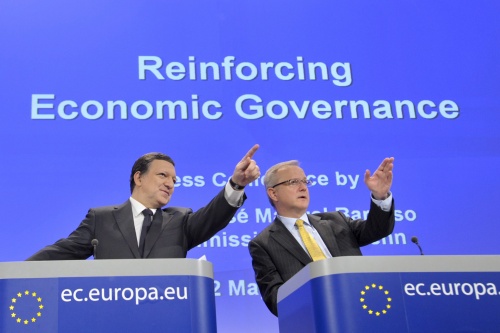 European commission, Jose Manuel Barroso (L) and Olli Rehn (R) pictured at a press conference on the Convergence report in Brussels, Belgium, on 12 May 2010. Photo by EPA/BGNES