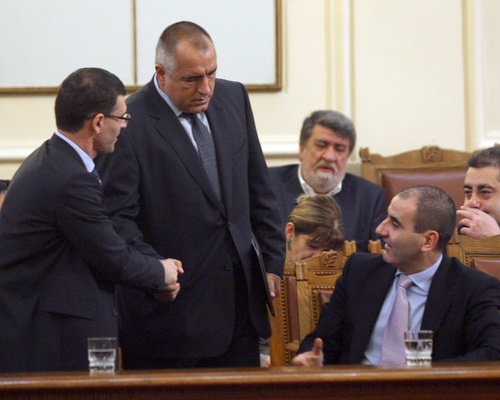
Bulgaria's Finance Minister Djankov (left) greets PM Borisov (middle) after the adoption of the 2010 State Budget Act at first reading. Photo by BGNES
Bulgaria's Parliament passed Tuesday the 2010 State Budget Act at first reading with minimum debate.
The 2010 State Budget Act was adopted with 135 votes in favor and 44 votes against. It was passed with the votes of the ruling majority from the governing GERB party and its allies from the Blue Coalition, the Ataka party, and the conservative RZS party, and was opposed by the Bulgarian Socialist Party and the ethnic Turkish Movement for Rights and Freedoms (DPS).
The only MP who took advantage of Parliamentary Chair Tsetska Tsacheva’s invitation to present their position on the budget was the Co-Chair
The new State Budget Act envisages a 2% decline of Bulgaria’s GDP in 2010. The projected 2010 state revenues amount to BGN 26,4 B, which is a 19% decline compared to the one in the 2009 State Budget, and about BGN 435 M more than what the government expects to have actually raised for all of 2009. The social security payments will be reduced by 2% starting January 2010.
All direct taxes are going to stay the same in 2010, and only some excise taxes are going to be increased, most notably the one on cigarettes – by 43% .
BGN 20,9 B are to come from taxes, and BGN 3,4 B from non-tax revenue. Aid, the main share of which will come from the EU budget, is planned at BGN 2 B.
Foreign investments, which collapsed from BGN 6,5 B to BGN 3 B in 2009, are projected at BGN 3,3 B.
The 2010 state spending is estimated at BGN 26,86 B. Some BGN 2,6 B, or 4,2% of the GDP, will be spent on health care. 15,1% of the GDP are planned for social security. The education sector will get 4,2% of the GDP. 1,6% of the GDP will be allocated for environment, and 3,1% for transport and communications. Bulgaria’s contribution to the EU budget is estimated at BGN 779,7 M.
Bulgaria’s employment ratio is expected to drop by 2,5%, and the unemployment is expected to stand at 11,4% at the end of 2010. The minimum monthly wage will remain at BGN 240.