Borissov Loses Patience: Political Bargaining Over Key Positions and Budget 2025
"Everyone wants positions – in regulatory bodies and ministries," he emphasized.
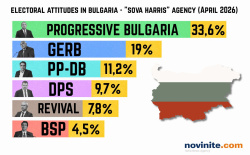
HOT: » Which party would you vote for (if you could) in the upcoming snap vote in Bulgaria on April 19?
 Send to Kindle
Italian Prime Minister, Silvio Berulsconi, should probably drink another vodka at the birthday party of his Russian counterpart and good friend, Vladimir Putin. His worse fears might materialize – Bulgaria’s Premier, Boyko Borisov, could soon beat him in the approval rankings.
During his official trip to Bulgaria last week, Berlusconi jokingly warned Borisov to be careful not to get a higher score than Berlusconi’s own, adding he was anxious his Bulgarian rival is inching closer and closer.
On Wednesday, the National Center for Study of Public Opinion (NZIOM) released the results from their latest poll showing the approval for Borisov’s cabinet reached 62% in October (growing by 11% from the 51% right after its appointment). 52% of Bulgarians say they would vote again for Borisov's Citizens for European Development of Bulgaria (GERB) party, while other parties in the Parliament are loosing ground more and more.
We, Bulgarians, seem to be finally happy with the work of the cabinet and approve, if not everything, at least most of what they do. A lasting love affair, regardless of the fact that any real progress remains hard to notice – most of the EU funds are still blocked, a corruption scandal is raging at the Supreme Judicial Council, the latest high-profile and yet unsolved kidnapping just took place while the Minister of Regional Development admitted he gave bonuses to his employees despite declarations coming from Borisov and Finance Minister Djankov that state employees would not get their usual end-of-year “13th salary” over the economic crisis.
It is, however, obvious that Bulgarian media have a lot to do with this dazzling image of Borisov and his guys, with the daily singing of praises and the portraying of heroic pictures of the Premier fighting the corrupt bad guys. Friends, working at a Sofia-based daily, tell me how their owner personally comes in every night, before the newspaper is sent to the printer, to check the articles about Borisov or how he looks on the pictures, and to take them out if he does not deem them flattering enough.
It is not Borisov’s fault after all. With his strong common sense, he, actually, seems to notice the irritating brown-nosing. He is yet to show much respect for the local media and either mocks, either scorns the reporters, who dare to ask him questions. His most recent remark: “I advise you to not read the media much, because I am tired of having to comment on what they have written.”
The gloomy reality about the integrity of most Bulgarian journalists can be found in the World Press Freedom Index 2009 released Tuesday by Reporters without Borders. Bulgaria’s press freedom ranks last in the European Union, slipping down, for the third year in a row, to 68th place in 2009, after being 48th in 2005, and hitting its best 35th spot in 2006. Countries such as Togo, Tanzania, Malawi, Liberia, Botswana, Lebanon, and Haiti are ranked before us while our neighbors Romania and Serbia, with which we so often compare and compete, are ranked 50th and 62nd respectively.
The sad truth is Bulgaria’s press still has not learned how to be free, even how to criticize. And how could it? 20 years after the fall of communism many of those “official communist regime journalists,” who were exposed to have been former State Security agents, continue to run the majority of our media, publish widely-circulated and well-read articles and books. They do remain the gurus in the profession.
It might be useful, however, to point out that a too strong of an approval for a ruler is not always such a good thing. Aren’t’ Borisov’s climbing ratings bringing us closer to Cuba or North Korea and further and further away from Europe? If I remember correctly, our own communist dictator, Todor Zhivkov, never hit anything less than the 100% bull’s-eye approval mark.

"Everyone wants positions – in regulatory bodies and ministries," he emphasized.

Boyko Borisov chose to cast his vote with a paper ballot in Bankya today.

Former Prime Minister Boyko Borissov announced that he had been summoned for questioning by caretaker Interior Minister Boyko Rashkov over alleged threats made to a Bulgarian businessman.

Resigned PM Boyko Borisov has appeared for the first time in months in front of the media.

With a surprise leave, the newly resigned prime minister Borisov avoided the hearing from the new parliament.

The meeting of the Monitoring Group on Democracy, Fundamental Rights and the Rule of Law in the European Parliament, at which the situation in Bulgaria will once again be discussed, will take place on 8 January, MEP Elena Yoncheva wrote on her Facebook pa
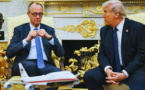
Nobody asked Europe whether it wanted this war. The US and Israel acted alone on February 28th, and the continent woke up to a crisis it had no hand in starting but now has no choice but to navigate.
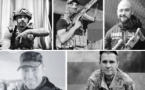
When Russia launched its full-scale invasion of Ukraine on February 24, 2022, it did not count on one thing: that among the defenders standing in its way would be Bulgarians.
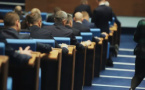
Bulgaria has a constitution, a parliament, and a president. What it has struggled to maintain, with remarkable consistency over the past decade, is an actual functioning government. Since 2021 alone, the country has cycled through five caretaker cabinets,

On the evening of December 1, 2025, Bulgaria witnessed its most significant popular mobilization since the 1990s

If we look at history, there are not many cases in which relations between Bulgaria and Russia at the state level were as bad as they are at the moment.

The term “Iron Curtain” was not coined by Winston Churchill, but it was he who turned it into one of the symbols of the latter part of the twentieth century by using it in his famous Fulton speech of 1946.
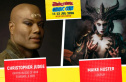
Aniventure Comic Con Returns to Bulgaria with Star Guest Christopher Judge!
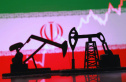
Global Fuel Shock: Oil Jumps Over 40% Since Iran War Began