
Earth Hour Spares Record 56 Megawatts of Electricity to Sofia
The power utility CEZ reports Sunday a record drop of 56 megawatts of electricity consumption in Bulgaria's capital Sofia during "Earth Hour 2012".
 Send to Kindle
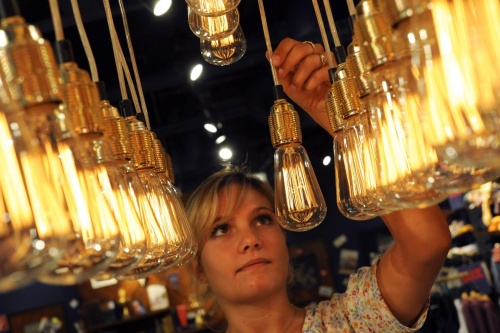 A young woman arranges one of many light bulbs which are used as decorations in a clothes store in Hanover, Germany. The traditional 100 watt light bulb will slowly disappear from the shelves of European shops from 01 September onwards. Photo by EPA/BGNES
A European Union ban on the manufacture and import of 100-watt and frosted incandescent light bulbs, in use since the 19th century, comes into force on September 1.
They are being phased out to encourage the switch to more energy-efficient fluorescent or halogen lamps, which use up to 80% less electricity.
Critics say the new bulbs are gloomy, and can trigger headaches and rashes in people with light sensitive disorders.
The ban is one of a series of measures in the EU to tackle climate change.
The less powerful clear bulbs will be progressively banned until all traditional bulbs disappear from shops across Europe in 2012.
The new rules follow an agreement reached by the 27 EU governments last year.
Some consumers have been stockpiling the old-style versions over concerns about the higher cost of the long-life bulbs, or for medical and sentimental reasons.
Several nations including Australia, New Zealand, the US, Canada and the Philippines have also announced plans to phase out traditional bulbs.
We need your support so Novinite.com can keep delivering news and information about Bulgaria! Thank you!

The power utility CEZ reports Sunday a record drop of 56 megawatts of electricity consumption in Bulgaria's capital Sofia during "Earth Hour 2012".

Bulgaria has produced its first compact fluorescent energy saving light bulbs that are said to have a lifespan of 12 000 hours, it has been announced.

Bulgaria's Minister of Defense Todor Tagarev admitted the possibility that an explosive device might have been planted on board the crashed plane in which Yevgeny Prigozhin was traveling

The European Commission has announced that it is preparing criminal proceedings against Bulgaria, Cyprus, Greece, Malta, and Portugal for incorrect application of the rules on the exchange of data on criminal records and the establishment of the relevant

The European Commission has started an evaluation of the Plan for Reconstruction and Development of Bulgaria, said the spokesman of the European Commission Eric Mamer. The document was submitted to the Commission on 15 October.

58% of Bulgarians do not support the introduction of the euro as the official currency in the country. This shows a study prepared by Trend agency specifically for the financial forum NEXT DIFI 2021, organized by b2b Media for the fifth year. The data dur

Too late Bulgaria began to explain its own position towards North Macedonia, as it should have been clear to our European partners some time ago.

An SPD-led government in Germany has significant potential to sharpen international attention to the problems of corruption in Bulgaria.

UN Happiness Report: Bulgaria's Astonishing Leap in Rankings

Bulgaria: 3 Regions With Lowest Life Expectancy - EU Report 2022


