The Associated Press
PLOVDIV, Bulgaria - The Vatican acknowledged for the first time Sunday that it may have to curtail Pope John Paul II's travel because of his feeble condition, suggesting that planned stops in Mexico and Guatemala in July could be dropped.
Papal spokesman Joaquin Navarro-Valls told reporters the pope will go to Toronto to mark the Roman Catholic Church's World Youth Day, but suggested the other stops on the proposed 11-day trip could be canceled.
"Toronto is clear. For the others, we shall see," Navarro-Valls said. "No decision has been made yet. Everything that has been confirmed is confirmed." But he added, "Something that has been confirmed can be unconfirmed."
Until now, the only papal trips postponed because of the John Paul's health were a 1994 visit to New York after the pontiff broke his leg and a trip to Armenia in 1999, when he came down with the flu.
On Sunday, John Paul's hands trembled and his voice was heavily slurred — symptoms of Parkinson's disease— as he wound up a stamina-testing four-day trip to Bulgaria.
As he has throughout the Bulgarian visit and his first stop in Azerbaijan, he read only a portion of his homily, turning it over to a priest to finish.
The pope honored three Catholic priests killed by Bulgaria's former communist regime, finding bonds with Orthodox Christians in their joint suffering during the Cold War.
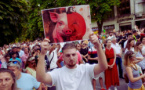
He was driven from Sofia to the city of Plovdiv in southern Bulgaria for an open-air Mass in a central square attended by some 20,000 people. Security was particularly tight, with sharpshooters on rooftops and windows of buildings overlooking the square covered.
The 82-year-old pope sat slumped in a white chair on the altar, looking feeble and weak. Beside him stood two Orthodox church officials who had accepted the pope's invitation, an encouraging sign for the Vatican, which has been seeking closer contacts as part of efforts to heal the millennium-old rift between Catholics and Orthodox believers.
John Paul beatified Kamen Vichev, Iosafat Shishkov and Pavel Dzhidzhov, all executed by firing squad in a Sofia prison in 1952, declaring them martyrs of the Roman Catholic faith. Beatification is the last step before possible sainthood.
They were close to Evgeni Bosilkov, Bulgaria's Catholic leader at the time, who was sentenced to death in the same trial. The pope beatified Bosilkov five years ago.
The pope said he felt "duty bound" to also honor the memory of Orthodox Christians "who suffered martyrdom under the same communist regime."
"This tribute of fidelity of Christ brought together the two ecclesial communities in Bulgaria, even to the supreme witness," the pope said in his homily.
He said the three martyred priests were models for Christians today, especially young people "who are looking to give meaning to their lives."
The visit to Bulgaria was John Paul's latest to a series of predominantly Orthodox countries, but he has so far been rebuffed in attempts to travel to Russia. Relations have been tense with the Orthodox leadership in Moscow, which has accused the Vatican of seeking to expand its influence in traditionally Orthodox lands.
However, the Vatican said Sunday that it was encouraged by the Orthodox church's reception of the pope in Bulgaria, and expressed optimism that it could lead to a meeting between John Paul and Russian Patriarch Alexy II.
"The pope expects that sooner or later he will meet with Alexy. We hope sooner," Navarro-Valls said before announcing that papal travel could be cut back.
Plovdiv, about 100 kilometers (60 miles) southeast of the capital, Sofia, is Bulgaria's second-largest city and home to most of the country's small community of 80,000 Catholics. Although the nation of 8 million is overwhelmingly Orthodox, small crowds of cheering admirers have greeted the pontiff at all of his stops.
Onlookers cheered and waved small Bulgarian flags as the bulletproof "popemobile" carried the pontiff to Plovdiv's central square, decorated with a Vatican emblem created from 100,000 flowers.
Many Bulgarians hoped the visit — the country's first-ever by a pope — would finally dispel lingering suspicions that Bulgarian secret agents were involved in the 1981 assassination attempt on the pope in St. Peter's Square in Rome.
At the time, Bulgaria was fiercely loyal to the former Soviet Union, whose KGB was said to have been alarmed at the popularity of the Solidarity labor movement in the pope's native Poland. An Italian court acquitted three Bulgarians of conspiracy charges, citing a lack of evidence.
Turkish gunman Mehmet Ali Agca is serving a life sentence in Italy for firing the shot that wounded John Paul.
Seeking to lay allegations of a Bulgarian connection to rest, the pope said in his arrival speech Thursday that he "never ceased" to love the Bulgarian people, and later in his visit said he never suspected that Bulgaria was involved.