By WILLIAM J. KOLE
Associated Press Writer
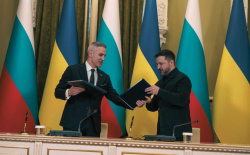
Pope John Paul II told Bulgaria's president on Friday that he never believed there was a Bulgarian connection to the 1981 attempt on his life.
The pope said he "never believed in the so-called Bulgarian connection because of my great esteem and respect for the Bulgarian people," according to a joint communique issued by the Vatican and President Georgi Parvanov after the two met.
It was the first time John Paul has publicly expressed his view about lingering suspicions that Bulgarian secret agents were behind Turkish gunman Mehmet Ali Agca's shooting of the pope in St. Peter's Square in Rome on May 13, 1981. An Italian court acquitted three Bulgarians of complicity in the attempted assassination, citing a lack of evidence.
The Bulgarian agents had been suspected of working for the Soviet KGB, and were said to have been alarmed by the pope's support for the Solidarity trade union in his native Poland.
Many Bulgarians had hoped that John Paul's visit - the first-ever by a pope to this formerly communist country - would finally dispel the allegations.In his arrival speech Thursday, the pope said he had "never ceased" to love the Bulgarian people.
"We had no interest in killing a pope. It's an absurd notion," said Petar Iliev, a 61-year-old Sofia retiree.
In the Vatican, church officials announced Friday that the pope has accepted the resignation of Milwaukee Archbishop Rembert Weakland, who was accused of sexual assault by a former theology student.
The Vatican cited Weakland's age as the reason for the resignation.Weakland submitted the resignation in April because he had turned 75, the mandatory retirement age. But he pressed the Vatican to speed up a decision on Thursday after acknowledging that he had paid $450,000 to the adult student to settle a claim of sexual assault more than two decades ago.
His church scandalized by allegations of sexual abuse by Catholic clergymen worldwide, John Paul on Friday condemned child pornography, forced prostitution and other crimes in a joint statement issued by the pope and Parvanov.
The pope also urged European leaders to return to the continent's Christian heritage, wading into a dispute within the European Union over whether the faith should be singled out in a draft constitution that would replace the EU's founding treaty.
Christianity was not mentioned in an EU Charter on European Rights and Values drafted two years ago. Critics said it was inappropriate to highlight the faith in an increasingly pluralistic society; Christian leaders disagree and are pushing for a mention of Christianity in the constitution being hammered out in Brussels, Belgium."
In searching for its own identity, the continent cannot but return to its Christian roots," the pope said in a meeting with Patriarch Maxim, the leader of Bulgaria's Orthodox Christians.
He called the spiritual message of the Roman Catholic and Eastern Orthodox churches "relevant even to those who, in the field of politics, are working to bring about European unification.
"The 82-year-old pope's four-day visit is a major test of his stamina. His speech is often slurred and his hands tremble - symptoms of Parkinson's disease - and he walks with difficulty because of knee and hip ailments. For the first time, a motorized platform was used for him to get on and off the papal aircraft so he wouldn't have to climb steps.
Although the pope was wheeled around on a special platform, he appeared rested and stronger than he did during his 24-hour stay in Azerbaijan, which preceded the Bulgaria visit.
He visited Sofia's main Orthodox cathedral Friday, and onlookers waved flowers and cheered as his bulletproof "popemobile" moved slowly through the streets of Sofia. Security was tight for the visit, with all 27,000 of the nation's police officers on duty or on standby.
The pope's meeting with Maxim, a feisty cleric who until recently had repeatedly snubbed the pontiff by refusing to see him, was the pope's latest effort to break down traditional barriers between the world's major religions and focus instead on the common values that bind them.
Icy relations between the Vatican and the Orthodox Church, which is suspicious of Roman Catholic expansion into traditionally Orthodox countries, have blocked the ailing pontiff's hopes of visiting Russia. On his visit to predominantly Orthodox Bulgaria, where similar tensions are simmering, John Paul was reaching out to a faith that has at times reviled him."
Today we can give thanks to God that the bonds between us have been much strengthened," the pope told Maxim.Healing Cold War rifts in Bulgaria, one of the former Soviet Union's most fiercely loyal satellites, could help pave the way for the visit to Russia that the pope has sought for so long.
"Unity! Unity!," a small group of Orthodox believers shouted outside the patriarch's residence.