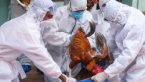
The herbivores in two Bulgarian villages will be vaccinated over suspicion for anthrax. Photo by BGNES
Veterinarians have started vaccinating against anthrax all herbivores in two villages near the Bulgarian cities of Yambol and Razgrad.
The villages of Stefan Karadzhovo and Brestovene were thought to be infected with anthrax.
Six sheep have died in village of Brestovene, but the sample is still expected to be confirmed by the diagnostic laboratory in the National Veterinary-Medical Service in Sofia.
A shepherd from the village of Stefan Karadzhovo was listed at the hospital in Yambol after being diagnosed with a form of skin anthrax, Darik radio reported Saturday. Georgi Drosev, 47, became infected after slaughtering a sick sheep.
Samples from the sheep could not be taken because were no remains of the slaughtered animal, which could have been contaminated. There was no information for other possibly infected sheep in the village.
“We have taken all possible measures. Besides vaccinating the animals, we also disinfected and isolated all the places to which the animals had access to,” said Pencho Kamenov, from the “Animal Welfare” department of the National Veterinary-Medical Service.
The Service has stated that anthrax is a highly contagious disease that is usually transmitted to humans by contact with meat, blood or skin of animals that have died from the disease.
In compliance with the state prevention program, the vaccination against anthrax is carried out every year in all the towns and villages in the country, in which there has been a registered case of anthrax disease over the past 30 years.
In locations where anthrax was registered in the past 10 years, the vaccination is carried out twice a year.
The animals from the village of Stefan Karadzhovo were vaccinated in September 2009, although there has not been a recorded case.
Vaccination has not been carried out in locations near the village of Brestovene because there has not been registered an anthrax case over the past 30 years.
There has not been a confirmed case of the disease all around Bulgariay for the past two years.